

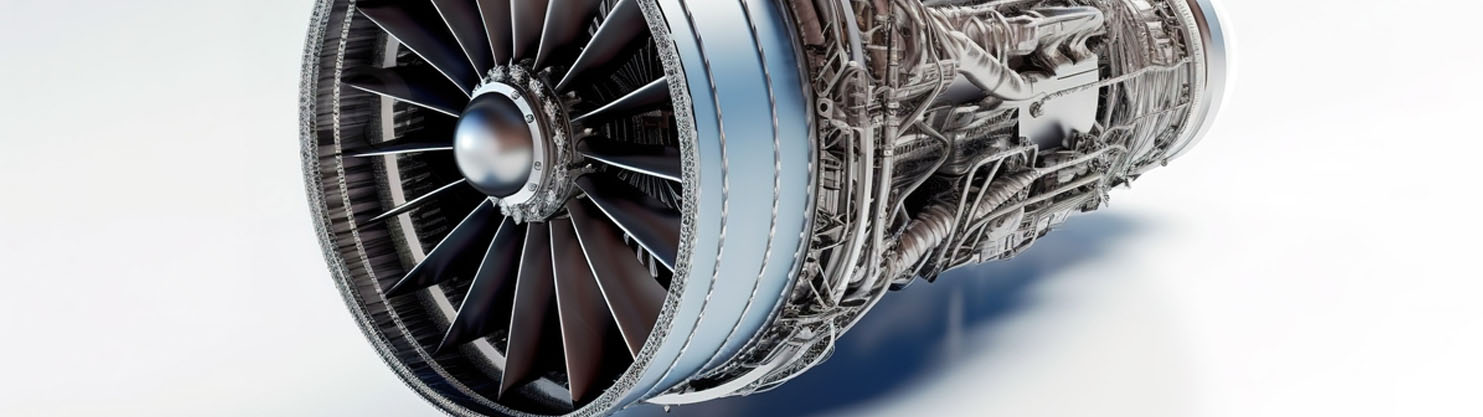
The Aeronautical Engineering Department at NMIT Bengaluru was established in 2011 with an undergraduate program for 60 students. The intake was further increased to 120 in the year 2020. The Post Graduate Program (M.Tech) in Defence Technology, which began in 2021-22, comprises a curriculum rigorously designed in collaboration with prestigious organizations such as DRDO and AICTE. Scientists and academicians connected with DRDO share their knowledge with students. Incorporating laboratory sessions that take place at DRDO's R & D facilities provides an enriching practical learning environment for the students.
By utilizing a variety of cutting-edge techniques, the department uses a multimodal strategy to improve teaching and learning. An organized framework that consists of course projects, industrial visits and internships, enhances the educational experiences of the students. To further transmit useful knowledge and real-world applications, the department also plans internal and external training events including conferences, workshops, seminars and flight training programs.
The department also offers Ph.D. program under Nitte (Deemed to be University) and Visvesvaraya Technological University. The department has sophisticated laboratory facilities that include an operable Cesna 172 aircraft, a Mig 21 aero engine, a low-speed subsonic wind tunnel, a UAV lab, an aircraft system lab, a propulsion lab, a structures lab, a simulation lab and an avionics lab. The department has also set up a full-fledged library which gives access to E-Books, Conference Proceedings, Magazines and online sources like AIAA journals.
The department organizes regular workshops, seminars, national /international conferences and competitions and thus encourages the faculty and students to actively participate in such events. Mandatory internships are facilitated in reputed industries and research institutes. Additionally, the department is involved in numerous funded projects granted by organizations such as ARDE, NSTL, GTRE, Dassault Systems and KSCST, fostering student involvement in research and development.
The department has arranged special coaching classes for Aerospace GATE preparation, in collaboration with reputable coaching centers, which has benefitted students in securing commendable GATE ranks. A good number of graduate students of the department have secured admission for higher studies in institutions like IISc, IITs, NITs and foreign universities. Graduates also find placements in MNCs such as Boeing, Airbus, TCS-Research, Tata Advance Systems, Infosys Technologies Limited, Wipro Aerospace, Capgemini, Tech Mahindra, Collins Aerospace and Axis Cades.
The department's alumni continue to excel, with many contributing to cutting-edge research organizations nationally and internationally.
Vision
To achieve recognition as a Department of Excellence by empowering graduates capable for multidisciplinary research, innovation, entrepreneurship and industry readiness in Aeronautical Engineering.
Mission
- M1 To establish a curriculum with state-of-the-art labs and modern equipment to support the academic and holistic growth of students and faculty.
- M2 To foster collaboration with top organizations and industries to advance knowledge, offer multidisciplinary teaching and promote research.
- M3 To develop critical thinking and innovation, adapting to evolving educational and industry trends while ensuring continuous progress.
- M4 To nurture an entrepreneurial mind-set among students meeting the dynamic needs of aeronautical engineering.
- PSO1: Graduates will demonstrate proficiency in designing and analysing various aircraft materials and structures, applying contemporary methodologies and tools for efficient and reliable solutions.
- PSO2: Graduates will exhibit the ability to develop innovative solutions for challenges in aerodynamics, propulsion and control systems used in aircraft, integrating theoretical knowledge with practical applications.
- WK1: A systematic, theory-based understanding of the natural sciences applicable to the discipline and awareness of relevant social sciences.
- WK2: Conceptually-based mathematics, numerical analysis, data analysis, statistics and formal aspects of computer and information science to support detailed analysis and modelling applicable to the discipline.
- WK3: A systematic, theory-based formulation of engineering fundamentals required in the engineering discipline.
- WK4: Engineering specialist knowledge that provides theoretical frameworks and bodies of knowledge for the accepted practice areas in the engineering discipline; much is at the forefront of the discipline.
- WK5: Knowledge, including efficient resource use, environmental impacts, whole-life cost, re-use of resources, net zero carbon and similar concepts, that supports engineering design and operations in a practice area.
- WK6: Knowledge of engineering practice (technology) in the practice areas in the engineering discipline.
- WK7: Knowledge of the role of engineering in society and identified issues in engineering practice in the discipline, such as the professional responsibility of an engineer to public safety and sustainable development.
- WK8: Engagement with selected knowledge in the current research literature of the discipline, awareness of the power of critical thinking and creative approaches to evaluate emerging issues.
- WK9: Ethics, inclusive behavior and conduct. Knowledge of professional ethics, responsibilities and norms of engineering practice. Awareness of the need for diversity by reason of ethnicity, gender, age, physical ability etc. with mutual understanding and respect and of inclusive attitudes.
Engineering graduates will be able to:
- PO1: Engineering Knowledge: Apply knowledge of mathematics, natural science, computing, engineering fundamentals and an engineering specialization as specified in WK1 to WK4 respectively to develop to the solution of complex engineering problems.
- PO2: Problem Analysis: Identify, formulate, review research literature and analyze complex engineering problems reaching substantiated conclusions with consideration for sustainable development. (WK1 to WK4)
- PO3: Design/Development of Solutions: Design creative solutions for complex engineering problems and design/develop systems/components/processes to meet identified needs with consideration for the public health and safety, whole-life cost, net zero carbon, culture, society and environment as required. (WK5)
- PO4: Conduct Investigations of Complex Problems: Conduct investigations of complex engineering problems using research-based knowledge including design of experiments, modelling, analysis & interpretation of data to provide valid conclusions. (WK8).
- PO5: Engineering Tool Usage: Create, select and apply appropriate techniques, resources and modern engineering & IT tools, including prediction and modelling recognizing their limitations to solve complex engineering problems. (WK2 and WK6)
- PO6: The Engineer and The World: Analyze and evaluate societal and environmental aspects while solving complex engineering problems for its impact on sustainability with reference to economy, health, safety, legal framework, culture and environment. (WK1, WK5 and WK7).
- PO7: Ethics: Apply ethical principles and commit to professional ethics, human values, diversity and inclusion; adhere to national & international laws. (WK9)
- PO8: Individual and Collaborative Team work: Function effectively as an individual and as a member or leader in diverse/multi-disciplinary teams.
- PO9: Communication: Communicate effectively and inclusively within the engineering community and society at large, such as being able to comprehend and write effective reports and design documentation, make effective presentations considering cultural, language and learning differences
- PO10: Project Management and Finance: Apply knowledge and understanding of engineering management principles and economic decision-making and apply these to one’s own work, as a member and leader in a team and to manage projects and in multidisciplinary environments.
- PO11: Life-Long Learning: Recognize the need for and have the preparation and ability for i) independent and life-long learning ii) adaptability to new and emerging technologies and iii) critical thinking in the broadest context of technological change. (WK8)
Engineering Accreditation Commission - Student Outcomes (SOs)
- An ability to identify, formulate and solve complex engineering problems by applying principles of engineering, science and mathematics.
- An ability to apply engineering design to produce solutions that meet specified needs with consideration of public health, safety and welfare, as well as global, cultural, social, environmental and economic factors.
- An ability to communicate effectively with a range of audiences.
- An ability to recognize ethical and professional responsibilities in engineering situations and make informed judgments, which must consider the impact of engineering solutions in global, economic, environmental and societal contexts.
- An ability to function effectively on a team whose members together provide leadership, create a collaborative and inclusive environment, establish goals, plan tasks and meet objectives.
- An ability to develop and conduct appropriate experimentation, analyze and interpret data and use engineering judgment to draw conclusions.
- An ability to acquire and apply new knowledge as needed, using appropriate learning strategies.
- PEO-1: Graduates will use aeronautical engineering knowledge, modern tools and innovative practices to succeed in industry, research and entrepreneurship.
- PEO-2: Graduates will continue learning through higher studies, research and professional development.
- PEO-3: Graduates will communicate and work effectively in teams.
- PEO-4: Graduate will practice professionalism, leadership, ethics and social responsibility.
The Aeronautical Engineering Department boasts state-of-the-art laboratories and cutting-edge computing facilities tailored to the specific needs of aeronautical engineering. These laboratories are organized in accordance with the curriculum and the latest advancements in aerospace technology. They encompass a range of areas, including Aircraft Structures, Aerodynamics for both low and high-speed calculations, Aircraft Propulsion, Flight Control Avionics, Aircraft Systems, Composite Materials, Solid Mechanics and an Advanced Computational and Design Lab. Notably, ongoing efforts are directed towards the development of labs such as the Aircraft Repair and Avionics labs.
Design, Modelling and Analysis Lab
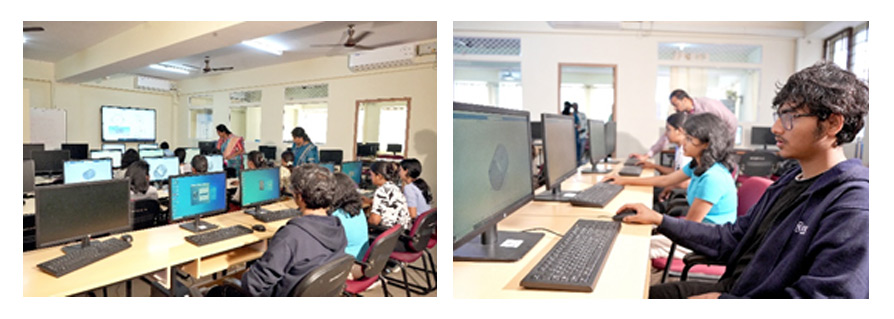
The laboratory is equipped with 65 high-performance computers featuring licensed versions of ANSYS and CATIA advanced software tools, specifically chosen to facilitate student learning and skill development in the realm of Computational Methods. Additionally, the lab is furnished with an overhead projector and screen to enhance the effectiveness of teaching and learning activities.
Aerodynamic Lab
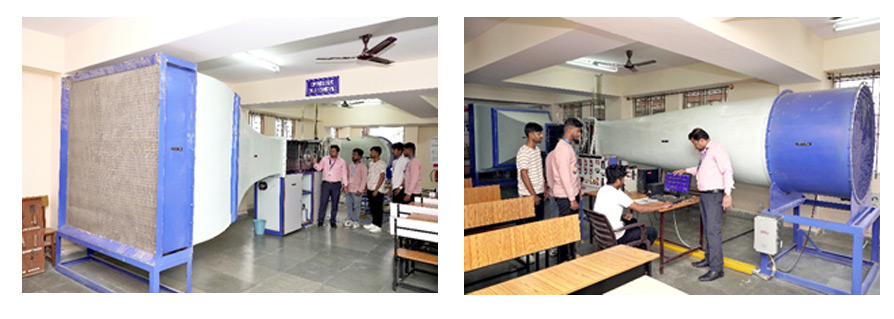
The Aerodynamics laboratory is furnished with a computerized Low-Speed Wind Tunnel, designed to showcase flow characteristics through the application of flow visualization techniques. The laboratory explores pressure distribution over diverse body shapes, including symmetrical airfoils, asymmetrical airfoils and cylinders. For in-depth analysis, the Wind Tunnel is equipped with a 3-Component Force Balance, enabling the study of lift, drag and pitching moments on airfoils at varying angles of attack and flow velocities.
Propulsion Lab
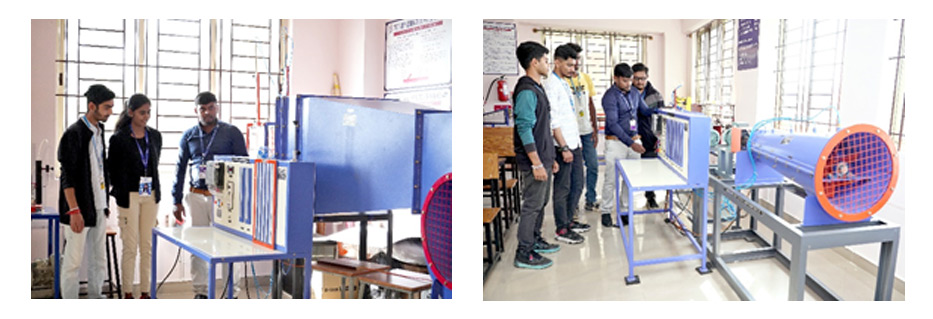
The primary focus of this laboratory is to educate Aeronautical Engineering students on the fundamental principles of Aircraft Propulsion, covering essential areas such as Heat Transfer, Combustion and Compressible Flow within the diverse components of Gas Turbines. Through the study of heat transfer, students gain insights into the correlation between heat transfer and engine operation, emphasizing its practical application in different engine components.
Structures Lab
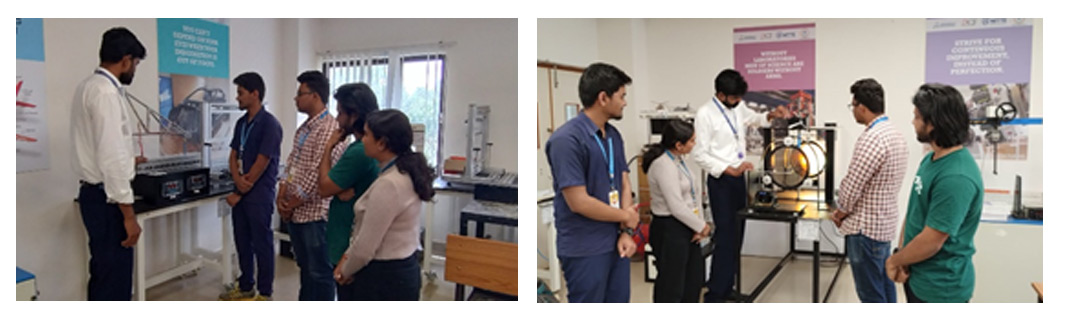
The lab is furnished with a cantilever beam setup, Wagner beam, beam vibration apparatus, photoelastic setup, column test arrangement and a variety of other equipment. Students will gain insights into load distribution in structural members and the factors contributing to deformation in structural components. This knowledge proves invaluable for students, especially in the design of aircraft structural elements such as wing-fuselage, landing gear and control surfaces. Furthermore, the lab offers material testing facilities, enhancing the learning experience for undergraduates and encouraging project work as part of their academic journey.
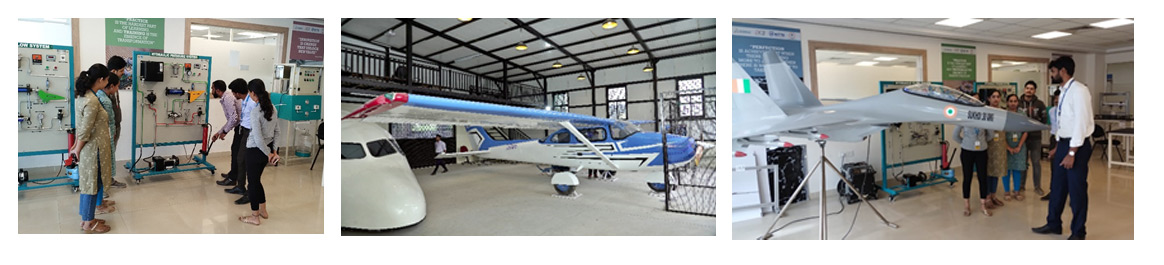
Aircraft systems lab
The primary goal of this laboratory is to prepare aircraft for airworthiness through a range of maintenance practices. It provides foundational knowledge about ground handling operations, including activities such as jacking, leveling and rigging of aircraft. The aircraft systems lab is instrumental in training students on inspection and servicing procedures commonly performed in the aviation industry. Equipped with essential tools like Adjustable Trestle, Screw Jack, Hydraulic Flow System, Hydraulic Pressure System, Fuel Flow System, Hydraulic Brake Load Torque Test and Hydraulic Braking System equipment, this lab serves as a practical learning ground. Upon completion of this laboratory, students pursuing B.E. in Aeronautical Engineering will have acquired the skills necessary to conduct maintenance operations, diagnose issues and address challenges in aircraft systems.
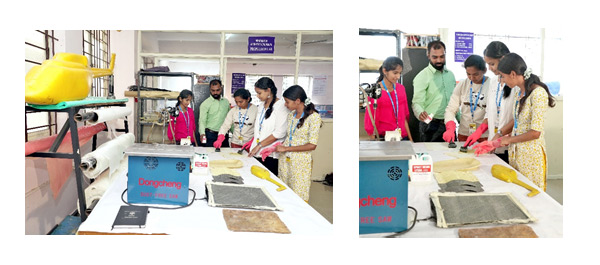
Composite materials lab
The Composite Materials Laboratory is actively involved in the exploration of polymer matrix composite materials, emphasizing their application in structural contexts. Within this facility, there are provisions for the design, manufacturing and experimental assessment of these materials. The lab boasts essential equipment such as a hand layup setup, filament winding machine, autoclave, compression testing apparatus, tensile testing equipment and an ultrasonic flaw detecting device. These resources collectively contribute to a comprehensive learning and research environment for the study and application of composite materials in various structural scenarios.
Simulation Lab
The laboratory is equipped with 25 high-end computers featuring licensed versions of MATLAB and SIMULINK, providing students with tools to explore and comprehend the stability of aircraft and spacecraft behavior across different operating conditions. Additionally, the structures laboratory serves as a platform to enrich the learning experience for undergraduate students, fostering project undertakings that allow them to apply theoretical knowledge in practical scenarios.
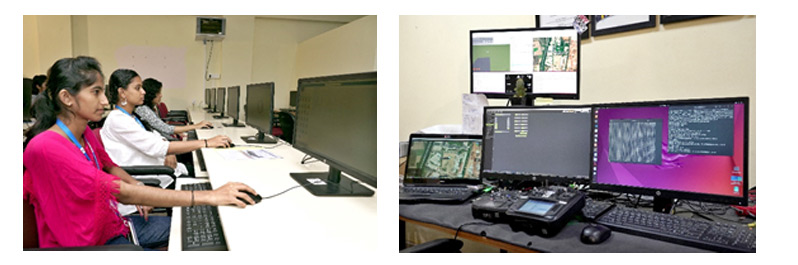
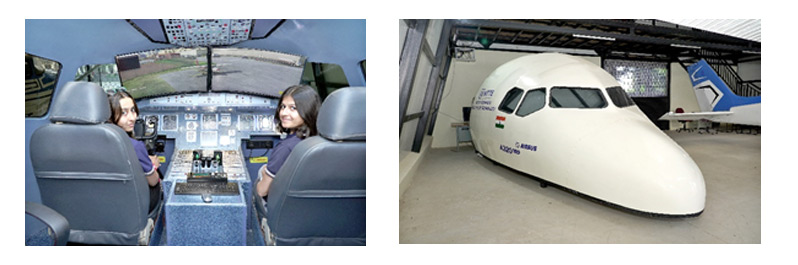
Unmanned Aerial Vehicle (UAV) Lab
The college's Unmanned Aerial Vehicle (UAV) laboratory functions as a specialized area for practical exploration and experimentation within the realm of unmanned aerial systems. This advanced facility is furnished with state-of-the-art technology and resources, ensuring that students gain a thorough grasp of UAV design, functioning and practical applications.
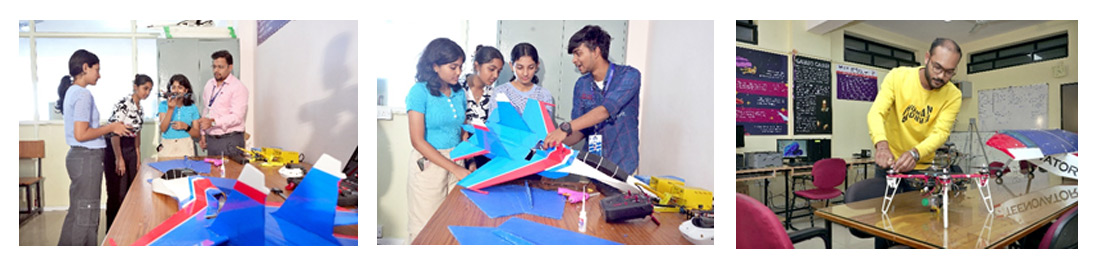
Avionics Lab
The Avionics Lab is a specialized facility within the realm of aviation education and research, dedicated to the study, development and practical application of avionics systems. Avionics, a portmanteau of "aviation" and "electronics," encompasses a wide array of electronic systems crucial for the safe and efficient operation of aircraft. The Avionics Lab provides a dynamic environment for students, engineers and researchers to delve into the complexities of these systems and understand their role in modern aviation.
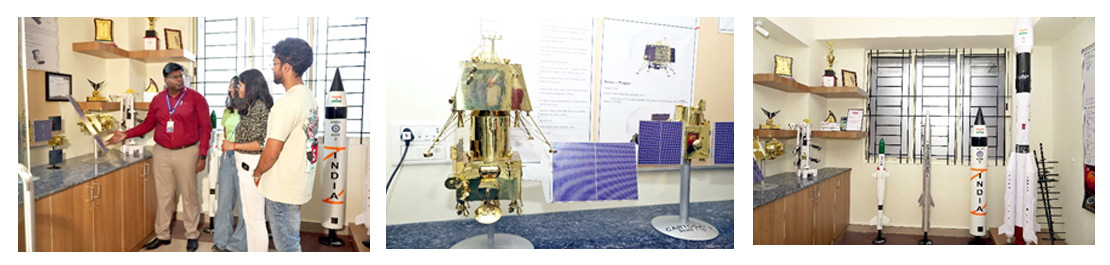
Board of Studies (BOS)
| Name | Designation | Position |
|---|---|---|
| Dr. Srikanth H V | Professor & Head, Dept. of Aeronautical Engineering NMIT, Bangalore |
Chairperson |
| Dr. Ravindra S Kulkarni | Professor, Aerospace Engineering, RV College of Engineering, Bangalore |
Academic Expert Member |
| Dr. Shashidhara S | Principal Engineer Aerostructures Department, Collins Aerospace, Bangalore |
Industry Expert Member |
| Mr. Kumar Prabat | Analyst Boeing |
Alumnus |
| Dr. N.N. Kishore | Adjunct Professor Dept. of Aeronautical Engineering, NMIT, Bangalore |
Member |
| Dr. Vinayaka N | Professor Dept. of Aeronautical Engineering, NMIT, Bangalore |
Member |
| Dr. Somashekar V | Associate Professor Dept. of Aeronautical Engineering, NMIT, Bangalore |
Member |
| Dr. Rajadurai Murugesan | Associate Professor Dept. of Aeronautical Engineering, NMIT, Bangalore |
Member |
| Dr. R Kousik Kumaar | Assistant Professor G-III Dept. of Aeronautical Engineering, NMIT, Bangalore |
Member Secretary |
| Dr. Sambhaji Shivaji Lore | Assistant Professor G-III Dept. of Aeronautical Engineering, NMIT, Bangalore |
Member |
BOE (Board of Examiners- BOE) for UG/PG
| Name | Designation | Organization | Position |
|---|---|---|---|
| Dr Srikanth H V | Professor & Head | NMIT, Bangalore | Chairperson |
| PG | |||
| Dr P N Tengli | Professor | NMIT, Bangalore | Member |
| Mr. G Narahari Datta | Professor | NMIT, Bangalore | Member |
| UG | |||
| Dr Rajadurai M | Associate Professor | NMIT, Bangalore | Member |
| Dr Somashekar | Associate Professor | NMIT, Bangalore | Member |
| Dr. Kousik Kumaar. R | Assistant Professor | NMIT, Bangalore | Member |
| Dr. Venugopal M M | Assistant Professor | NMIT, Bangalore | Member |
| Mr. Mahendra M A | Assistant Professor | NMIT, Bangalore | Member |
| Mr. Siddalingappa P K | Assistant Professor | NMIT, Bangalore | Member |
| Dr. Jini Raj R | Assistant Professor | NMIT, Bangalore | Member |
| Mrs. Sonali Gupta | Assistant Professor | NMIT, Bangalore | Member |
| Mr. Prashant Manvi | Assistant Professor | NMIT, Bangalore | Member Secretary |
| Mr. G Narahari Datta | Professor | NMIT, Bangalore | Member |
| Mr. G Ram Vishal | Assistant Professor | NMIT, Bangalore | Member |
| Mr. Vinod L | Assistant Professor | NMIT, Bangalore | Member |
| Mr. Praveen N | Assistant Professor | NMIT, Bangalore | Member |
Department Undergraduate Committee (DUGC)
| Name | Designation | Organization | Position |
|---|---|---|---|
| Dr. Srikanth H V | Professor & Head | NMIT, Bangalore | Chairperson |
| Dr. P N Tengli | Professor | NMIT, Bangalore | Member |
| Mr. G Narahari Datta | Professor | NMIT, Bangalore | Member |
| Gp Capt. C A Somaih | Adjunct Professor | NMIT, Bangalore | Member |
| Dr. N.N. Kishore | Adjunct Professor | NMIT, Bangalore | Member |
| Dr. Vinayaka N | Professor | NMIT, Bangalore | Member |
| Dr. Rajadurai M | Associate Professor | NMIT, Bangalore | Member |
| Dr. Somashekar V | Associate Professor | NMIT, Bangalore | Member |
| Dr. Kousik Kumaar. R | Assistant Professor | NMIT, Bangalore | Member |
| Dr. Venugopal M M | Assistant Professor | NMIT, Bangalore | Member |
| Dr. Sambhaji Shivaji Lore | Assistant Professor | NMIT, Bangalore | Member |
| Dr. Jini Raj R | Assistant Professor | NMIT, Bangalore | Member |
| Dr. Deenadayalan K | Assistant Professor | NMIT, Bangalore | Member |
| Mr. Siddalingappa P K | Assistant Professor | NMIT, Bangalore | Member |
| Mr. Prashant Manvi | Assistant Professor | NMIT, Bangalore | Member Secretary |
| Mr. G Ram Vishal | Assistant Professor | NMIT, Bangalore | Member |
| Mrs. Thara L | Assistant Professor | NMIT, Bangalore | Member |
| Mr. Abhishek T K | Assistant Professor | NMIT, Bangalore | Member |
| Mr. Mallapa Jabade | Assistant Professor | NMIT, Bangalore | Member |
| Ms. Fareen Nizami | Assistant Professor | NMIT, Bangalore | Member |
| Mrs. Sonali Gupta | Assistant Professor | NMIT, Bangalore | Member |
| Mr. Praveen N | Assistant Professor | NMIT, Bangalore | Member |
| Mr. Rahul B | Assistant Professor | NMIT, Bangalore | Member |
| Mrs. Pooja Chaubdar | Assistant Professor | NMIT, Bangalore | Member |
| Mr. Deepak Kumar P | Assistant Professor | NMIT, Bangalore | Member |
| Mr. Vinod L | Assistant Professor | NMIT, Bangalore | Member |
| Mr. Mahendra M A | Assistant Professor | NMIT, Bangalore | Member |
Department Advisory Committee (DAC)
| Name | Designation | Position |
|---|---|---|
| Dr. Srikanth H V | Professor & Head, Dept. of Aeronautical Engineering NMIT, Bangalore |
Chairperson |
| Dr. Ravindra S Kulkarni | Professor, Aerospace Engineering, RV College of Engineering, Bangalore |
Academic Expert Member |
| Dr. Shashidhara S | Principal Engineer Aerostructures Department, Collins Aerospace, Bangalore |
Industry Expert Member |
| Mr. Kumar Prabat | Analyst Boeing |
Alumnus |
| Dr. R Kousik Kumaar | Assistant Professor G-III Dept. of Aeronautical Engineering, NMIT, Bangalore |
Member Secretary |
| All faculty members | Dept. of Aeronautical Engineering, NMIT, Bangalore |
Members |
| Ms. Jeevitha R Shetty | Final Year Student Dept. of Aeronautical Engineering, NMIT, Bangalore |
Member |
| Ms. Sanjana Manjunath Hegde | Pre-final Year Student Dept. of Aeronautical Engineering, NMIT, Bangalore |
Member |
Programme Advisory Committee (PAC)
| Name | Designation | Position |
|---|---|---|
| Dr. Srikanth H V | Professor & Head, Dept. of Aeronautical Engineering NMIT, Bangalore |
Chairperson |
| Dr. Ravindra S Kulkarni | Professor, Aerospace Engineering, RV College of Engineering, Bangalore |
Academic Expert Member |
| Dr. Shashidhara S | Principal Engineer Aerostructures Department, Collins Aerospace, Bangalore |
Industry Expert Member |
| Mr. Kumar Prabat | Analyst Boeing |
Alumnus |
| Dr. N.N. Kishore | Adjunct Professor Dept. of Aeronautical Engineering, NMIT, Bangalore |
Member |
| Dr. Vinayaka N | Professor Dept. of Aeronautical Engineering, NMIT, Bangalore |
Member |
| Dr. Somashekar V | Associate Professor Dept. of Aeronautical Engineering, NMIT, Bangalore |
Member |
| Dr. Rajadurai Murugesan | Associate Professor Dept. of Aeronautical Engineering, NMIT, Bangalore |
Member |
| Dr. R Kousik Kumaar | Assistant Professor G-III Dept. of Aeronautical Engineering, NMIT, Bangalore |
Member Secretary |
| Dr. Sambhaji Shivaji Lore | Assistant Professor G-III Dept. of Aeronautical Engineering, NMIT, Bangalore |
Member |
| Mr. Siddalingappa P K | Assistant Professor G-II Dept. of Aeronautical Engineering, NMIT, Bangalore |
Member |
| Mr. Prashant Manvi | Assistant Professor G-II Dept. of Aeronautical Engineering, NMIT, Bangalore |
Member |
| Ms. Jeevitha R Shetty | Final Year Student Dept. of Aeronautical Engineering, NMIT, Bangalore |
Member |
| Ms. Sanjana Manjunath Hegde | Pre-final Year Student Dept. of Aeronautical Engineering, NMIT, Bangalore |
Member |
Innovative teaching methods
Pedagogical initiatives:
Faculty members employ diverse pedagogical strategies, such as demonstrations, presentations, video lectures, interactive teaching methods, animations and collaborative learning approaches featuring real-world illustrations, to cultivate an optimal learning environment as needed.
Collaborative learning:
Regarding collaborative learning, the following initiatives are scheduled: a minimum of two industrial visits per semester per class, guest lectures organized based on industry/academia gap analysis, integration of ICT-supported learning tools such as NPTEL, courser and webinars into the regular academic schedule. Additionally, students are motivated to participate in internships and industrial projects.
| Innovations by the Faculty in Teaching and Learning |
|---|
| Learning with the aid of technology (LMS, Department YouTube channel, Individual faculty website, Google Classroom, simulation software-based learning) |
| Active Learning Strategy through the Flipped Classroom approach |
| Collaborative Teaching and Learning Methodology (Peer Learning, group projects) |
| Learning through industrial visits and industrial projects |
| Guest Lectures & Technical Talks by Industry Experts |
| Courses conducted by industry expert members |
| Competitions |
| Paper publications |
| Techno-cultural fest |
| Alumni Interaction |
| Internship & Short-term Courses |
| Assignments, Seminar, Case Study |
| Self-Learning & E-Learning |
- Objective:The main goal is to use technology for an enhanced, accessible and engaging learning experience. This involves integrating digital tools to support diverse learning styles and improve overall educational outcomes.
- Methodology: Incorporating online platforms, multimedia, apps, virtual simulations and interactive content, the methodology creates a dynamic learning environment, harnessing technology's full potential for teaching and learning. LMS for organizing and delivering course content, departmental YouTube channels for video-based learning, Google Classroom, simulation software for interactive and practical learning. Faculty websites for resource dissemination.
- Learning Outcomes:Technology enhances accessibility for flexible learning, boosts engagement with interactive elements, supports personalized learning paths, fosters collaboration through online tools and prepares students for the digital age, equipping them with essential digital literacy skills.
- Objective: To shift the traditional learning model by having students engage with course content independently before class, allowing in-class time for interactive and application-based activities.
- Methodology of Flipped Classroom: Involves students independently accessing pre-recorded lectures or materials before class, followed by interactive discussions, collaborative projects and problem-solving activities during class sessions.
- Learning Outcomes of Flipped Classroom: Enhanced comprehension through pre-class exposure, increased engagement in interactive activities during class and improved critical thinking and application skills.
- Objective: To shift the traditional learning model by having students engage with course content independently before class, allowing in-class time for interactive and application-based activities.
- Methodology of Flipped Classroom:Involves students independently accessing pre-recorded lectures or materials before class, followed by interactive discussions, collaborative projects and problem-solving activities during class sessions.
- Learning Outcomes of Flipped Classroom:Enhanced comprehension through pre-class exposure, increased engagement in interactive activities during class and improved critical thinking and application skills.
- Objective: Collaboration in teaching aims to create an inclusive environment through joint efforts among educators, resulting in improved problem-solving, enhanced communication, diversity promotion, teamwork development and increased student engagement.
- Methodology: Educators collaborate through joint planning, implementing interdisciplinary projects and integrating technology for effective communication. The methodology emphasizes creating an inclusive and interactive learning environment, minimum of one industrial visit per semester, webinar seminars and Guest Lecture experts from industry / academia and through clubs Activity.
- Learning Outcomes: Collaborative activities enhance problem-solving and communication skills, promote diversity, develop teamwork abilities and increase student engagement, fostering a dynamic and inclusive learning environment.
Learning through Industrial Visit
- Objective: To provide real-world exposure by visiting industrial settings, bridging the gap between theoretical knowledge and practical applications for a holistic learning experience.
- Methodology:Involves organized tours to industrial facilities, allowing students to observe processes, interact with professionals and gain insights into industry practices.
- Learning Outcomes: Enhanced understanding of industry operations, application of theoretical knowledge in a practical context and improved awareness of industrial processes and challenges.
- Objective: To apply theoretical concepts in practical scenarios through hands-on projects, fostering problem-solving skills and industry relevance.
- Methodology:Involves students working on real-world projects, collaborating with industry experts and applying theoretical knowledge to address practical challenges.
- Learning Outcomes:Enhanced problem-solving abilities, practical application of theoretical concepts, development of teamwork and communication skills and better preparation for professional challenges.
- Objective:To provide students with insights from industry professionals, offering real-world perspectives to enhance their understanding of industry trends, practices and advancements.
- Methodology: Involves inviting industry experts to deliver lectures, share experiences and engage in interactive sessions, providing students with direct exposure to current industry knowledge.
- Learning Outcomes: Increased awareness of industry trends, practical insights into real-world applications, networking opportunities and a bridge between academic concepts and industry practices.
- Objective:To offer courses taught by industry experts, ensuring students receive firsthand knowledge, practical insights and real-world applications relevant to their field of study.
- Methodology: Involves designing curriculum content, delivery and assessment in collaboration with industry professionals, creating a comprehensive learning experience that aligns with current industry standards.
- Learning Outcomes: Enhanced practical skills, in-depth understanding of industry practices, networking opportunities and improved employability through exposure to real-world applications and expertise.
- Objective: To foster a spirit of healthy competition, providing students with opportunities to showcase their skills, creativity and problem-solving abilities in various domains.
- Methodology of Competitions: Involves organizing and participating in diverse competitions, spanning academic, technical and extracurricular fields, encouraging collaboration, innovation and continuous improvement.
- Learning Outcomes: Enhanced problem-solving skills, improved teamwork, honed communication abilities, increased self-confidence and a platform for showcasing individual talents and achievements.
- Objective: To contribute to academic knowledge and discourse by disseminating research findings through the publication of scholarly papers.
- Methodology:Involves conducting rigorous research, writing and submitting papers to reputable journals or conferences, contributing to the academic community and fostering knowledge dissemination.
- Learning Outcomes: Enhanced research and writing skills, increased visibility and recognition within the academic community and the dissemination of valuable knowledge to a wider audience.
- Objective: To provide a platform for students to showcase their technical and creative talents, fostering a vibrant andInvolves organizing a diverse range of events, including technical competitions, cultural performances, workshops and exhibitions, to engage students and promote a sense of community.
- Learning Outcomes: Enhanced event management and organizational skills, improved teamwork, increased creativity and a vibrant campus atmosphere that encourages collaboration and expression of diverse talents.
- Objective: To establish a meaningful connection between current students and alumni, facilitating knowledge exchange, mentorship and networking opportunities.
- Methodology: Every year Involves organizing events such as alumni meets, panel discussions and networking sessions, creating platforms for students to benefit from the experiences and insights of successful alumni.
- Learning Outcomes: Enhanced career guidance, expanded professional networks, inspiration from alumni success stories and a sense of belonging and continuity within the academic community.
- Objective: To provide students with practical industry exposure through internships and short-term courses, enhancing their employability and real- world skills.
- Methodology:Involves facilitating internships with industry partners and offering short-term courses designed to address specific skill gaps, ensuring students gain hands-on experience and relevant knowledge.
- Learning Outcomes: Improved practical skills, industry- relevant knowledge, increased adaptability and enhanced readiness for the professional workforce.
- Objective: To deepen understanding, encourage critical thinking and foster practical application of knowledge through assignments, seminars and case studies.
- Methodology: Involves designing challenging tasks, facilitating knowledge-sharing in seminars and analysing real-world scenarios through case studies, promoting active learning and engagement.
- Learning Outcomes:Enhanced analytical and problem- solving skills, improved communication and presentation abilities and the application of theoretical knowledge to practical situations for a holistic learning experience.
- Objective: To promote independent learning and self-motivation, fostering a sense of curiosity and lifelong learning skills.
- Methodology:Involves providing resources, encouraging research and facilitating a learner-centric environment where students take responsibility for their educational journey through NPTEL, Coursera, Swayam, Udemy, etc.
- Learning Outcomes: Increased self-motivation, improved research and information retrieval skills and the ability to adapt to diverse learning environments, cultivating a lifelong learning mindset.
Learning with the aid of technology.
LMS (Learning Management system)
Active Learning Strategy through the Flipped Classroom approach
Active Learning Strategy through the Flipped Classroom approach
Collaboration Teaching and learning methodology (Peer Learning, group projects)
Projects based Learning
Guest Lecture & Technical Talk by Industry Experts
Course through Industry Experts
Learning
Paper Publication
Techno-Cultural Fest
Alumni Interaction
Internship & Short-term Courses
Assignments, Seminars & Case Studies
Self-Learning & E-Learning
Faculty
Research
The Department of Aeronautical Engineering fosters innovation through advanced research and strategic industry collaborations. In partnership with various defense and aviation organizations, including ARDE, ADE, GTRE, NSTL, DEBEL, ISRO and Dassault Systèmes, the department has elevated its research and development initiatives to unprecedented levels. Furthermore, it holds recognition as a Research Centre under Visvesvaraya Technological University. With a dedicated team of professionals and state-of-the-art infrastructure, the department engages in diverse research domains such as Aerospace Materials and Design, Aerodynamics, Aerospace Propulsion, Aerospace Structure, Computational Fluid Dynamics (CFD), Flight Dynamics and Control, Navigation & Guidance and Space Technology.
To fortify our commitment to advancing knowledge and fostering industry-relevant expertise, the Department operates under a steadfast motto:
- Aligning Research Strengths with Industry Needs:We prioritize aligning our research strengths and resources with the dynamic needs of the aerospace industry. This ensures that our endeavors are not only academically significant but also commercially applicable.
- Providing Comprehensive Research Services:Our mission encompasses offering research services, specialized facilities and innovative technologies for real-world applications. This approach aims to contribute to the advancement of the aerospace sector.
- Internship and Financial support:Actively supporting students in securing internships across diverse government and private organizations, our goal is to facilitate a smooth transition from academia to the industry. Our dedication to cultivating talent encompasses providing scholarships, sponsoring facilities and collaborating with renowned entities such as Karnataka State Council for Science and Technology Dassault Systems, Boeing and Collins Aerospace. Additionally, we strive to establish endowed chairs as part of our ongoing commitment.
- Industry Relations and Collaborations:Ensuring strong relationships with the industry is deeply embedded in the department's ethos. Our goal is to forge connections with crucial industry partners, enhance current corporate relationships and effectively coordinate research and development activities within the aviation/aerospace, engineering and related sectors
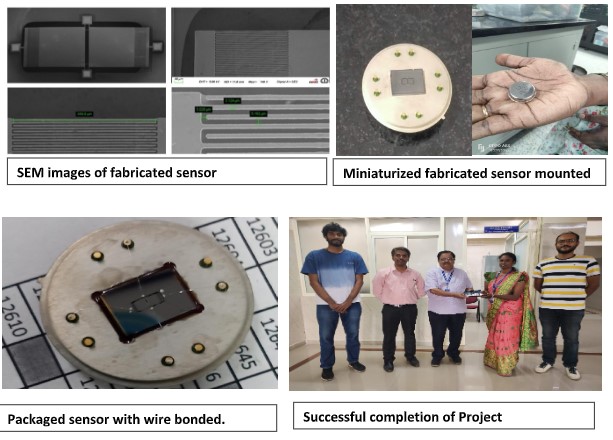
Design, Simulation, Fabrication, Packaging and characterization of MEMS-based Sound Source localizer for Gunshot events.
A Novel MEMS sound source localizer was developed to know the direction of gunshot events, exclusively at Centre for Nanomaterials and MEMS, Nitte Meenakshi Institute of Technology, Bengaluru in support with Infab Technologies, CeNSE, IISc, Bengaluru, SITAR, DRDO, Bengaluru, CMTI, Bengaluru. The funded R&D Project (Rs 26 Lakhs) was awarded by the ARMAMENT Research Board, ARDE, DRDO Lab, Pune.
The Principal Investigators of the project are Ms Nithya G, Department of ECE, NMIT, Bengaluru and Dr P N. Tengli, Department of Aero, NMIT, Bengaluru.
Sponsored Projects
| Title of the Funded Project | Name of the Funding Agency | Amount Received in Rs. | Name of the PI/Co-PI | Date of the Sanction of Project | Duration of the Project | Status |
|---|---|---|---|---|---|---|
| Formation Controller for a Swarm of Fixed Wing Aircrafts | ADE – DRDO | Rs. 9,73,500/- | Dr. P.N. Tengli, Dr. Jini Raj. R, Deepak Kumar | 03/08/2026 | 29/072027 | Granted |
| Enabling Early Hands-on learning for Students in Space domain - Creation of Domain based 3D Digital Learning content & robust curriculum for ModelRocket | Dassault Systèmes Foundation | Rs. 4,00,000/- | Dr. Jini Raj R | 28/01/2026 | 1 Year | Granted |
| Vertical Axis Wind Turbines (VAWTs) design & optimization using composite materials | Dassault Systèmes | Rs. 1,00,000/- | Dr. Jini Raj R | 13/01/2026 | 1 Year | Granted |
| Revolutionizing Space Education with Virtual Twin for accelerated hands-on learning | Virtual Twin for CubeSat | Dassault Systèmes | Rs. 19,37,500/- | Dr P N Tengli and Prof. Narahari Datta | 31-03-2026 | 1 Year | Ongoing |
| Design and Optimization of Flexible Propeller for MAV Application | Karnataka State Council for Science and Technology, IISc-Bangalore, 47th series | Rs. 6,000/- | Mr. DEEPAK KUMAR Dr. JINI RAJ. R |
March 2026 | 1 Year | Ongoing |
| Development of Next-Generation Bio Inspired Morphing Leading-Edge Tubercles of Wings to Enhance Fuel Efficiency and Manoeuvrability In Unmanned Aerial Vehicles | Karnataka State Council for Science and Technology, IISc-Bangalore, 47th series | Rs. 6,000/- | Dr. JINI RAJ.R | March 2026 | 1 Year | Granted |
| Comparison of mixing phenomenon & flow patterns inside 2 blade VPM and 3 blade VPM and modelling of scale up factor between mixers for prediction of mechanical properties and viscosity | ACEM DRDO, Nashik | Rs. 9.52 Lakhs | Dr. Prahalad N. Tengli, Mr. Mallappa Jabade, Dr. Srikanth, Mr. Siddalingappa P K and Mr. Barath Kumar | 18th July 2025 | 2 years | Sanctioned |
| Development of Green composites for Ground Crew Helmets | LSRB, DRDO | Rs. 42,70,127/- | Dr. P N Tengli, Dr. M S Thakur, Dr. Sandeep Kumar, Mr. G Ram Vishal | July 2023 | 3 years | Ongoing |
| Swarm Drones | Dassault Systems Foundation | Rs. 22,00,000/- | Dr. P N Tengli, Dr. Balachandra, Mr. Siddalingappa P K, Mr. Mallapa | Sept 2023 | 2 years | Ongoing |
| Production of Hydrogen from Sea Water Electrolysis using a Photovoltaic/Wind energy hybrid system using economically specialized membrane | STARS, MOE (IISc) | Rs. 25,00,000/- | Dr. M. S. Thakur, Dr. P N Tengli, Dr. V. Sridhar | July 2023 | 2 years | Ongoing |
| Investigation on Static and Dynamic Behaviour of 3d Woven Hybrid Carbon Aramid Epoxy Composite Laminate | Karnataka State Council for Science and Technology, IISc-Bangalore, 46th series | Rs. 6000/- | Mr. G Ram Vishal | 24/02/2023 | 6 months | Completed |
| Mechanical Behavior of Glare for Aerospace Applications | Karnataka State Council for Science and Technology, IISc-Bangalore, 46th series | Rs. 6000/- | Mr. G Ram Vishal | 24/02/2023 | 6 months | Completed |
| Development of Signal Denoising and Processing Algorithm for Tip Clearance | GTRE, DRDO | Rs. 8,07,200/- | Dr. P N Tengli, Dr. Sunil H, Nitya G | June 2022 | 2 years | Ongoing |
| Design, Simulation, Fabrication, Packaging and Characterization of MEMS-based Sound Source Localizer for Gunshot Events | ARMament Research Board, Defence R&D Organization | Rs. 24,04,512/- | Dr. P N Tengli | 21/06/2022 | 2 years | Ongoing |
| Design, Fabrication and Analysis of Composite Multi-cell Structures | Karnataka State Council for Science and Technology, IISc-Bangalore | Rs. 8000/- | Mr. Sridhar K | 24/04/2021 | 6 months | Completed |
| Design and Development of Amphibious Drone | Naval Science & Technological Laboratory (DRDO), Visakhapatnam andhra Pradesh | Rs. 9,44,000/- | Dr. P N Tengli | 03/03/2021 | 6 months | Completed |
| To Simulate the Effect of Pressure Oscillations of a Solid Propellant Rocket Motor using CFD and its Effect on Rocket Flight Stability | ARDE (DRDO), Pune | Rs. 9,50,000/- | Dr. Srikanth HV, Dr. AK Sarkar, Mr. Suthan R | 25/08/2020 | 1 year | Completed |
| Enabling Early Hands-on Learning for Students in Space Domain - Creation of Domain-based 3D Digital Learning Content & Robust Curriculum for Model Rocket | Dassault Systemes | ₹ 6,00,000/- | Dr. Jini Raj R and Mr. Praveen N | 28th Feb 2026 | 1 Year | Sanctioned |
| Vertical Axis Wind Turbines (VAWTs) Design & Optimization Using Composite Materials | Dassault Systèmes | ₹ 1,00,000/- | Dr. Jini Raj R | 30th Jan 2026 | 1 Year | Sanctioned |
The Centre for Aerospace Research is dedicated to advancing academic research in the field of aerospace. This prestigious affiliation is designed to foster an environment where innovation and scholarly excellence thrive.
At the Centre, we welcome researchers from diverse academic backgrounds. Our research programs cater to both full-time and part-time scholars, encompassing faculty members from various relevant disciplines, as well as postgraduate students eager to contribute to cutting-edge research.
Our department is staffed with highly proficient faculty members who bring a wealth of knowledge and experience from both academic and industrial spheres. These distinguished professionals serve as research supervisors, providing invaluable guidance and mentorship to our scholars. Their dual exposure to theoretical frameworks and practical applications ensures that our research is both rigorous and relevant, addressing contemporary challenges in the aerospace industry.
By combining academic rigor with industrial insights, the Centre for Aerospace Research is committed to producing impactful research that contributes to the advancement of aerospace technology and innovation. Our goal is to cultivate a robust research community that not only excels in scholarly pursuits but also drives technological progress and industrial development.
Research Supervisors:
| Name of the Faculty | Research area |
|---|---|
| Dr. SRIKANTH H V | Alternate fuels, IC Engines, Composite materials, CFD |
| DR. VINAYAKA N | AIRCRAFT STRUCTURES, AIRCRAFT MATERIALS, AERODYNAMICS |
| Dr. RAJADURAI M | Aerospace Structures, Materials |
| Dr. SOMASHEKAR V | Aerodynamics (CFD + Experimental), Unmanned Aerial Vehicles, Micro Aerial Vehicles, Sustainable Aviation Systems, Multidisciplinary/Interdisciplinary research |
| Dr. KOUSIK KUMAAR R | Aircraft structural analysis, Metal matrix composites, Tribology, Composites, Materials Characterization, Finite Element Analysis and Additive manufacturing |
| DR. VENUGOPAL M M | Aerodynamics, Aircraft Materials |
| Dr. SAMBHAJI SHIVAJI LORE | Composite Structures, Non-linear Analysis, Reliability Analysis, Uncertainty Quantification, Finite Element Analysis |
| Dr. DEENADAYALAN k | Surface Engineering, Coatings, Tribology, Laser Processing, Additive manufacturing and Composite materials. |
Facilities:
The Aeronautical Engineering Department is equipped with state-of-the-art laboratories and advanced computing facilities, meticulously designed to meet the specific demands of aeronautical engineering research. These laboratories are structured to align with the curriculum and reflect the latest advancements in aerospace technology.
Our research facilities cover a comprehensive range of specialized areas, including:
- Aircraft Structures: Dedicated to the study and analysis of the integrity and durability of aircraft frameworks.
- Aerodynamics: Equipped for both low and high-speed calculations, enabling detailed aerodynamic analyses and simulations.
- Aircraft Propulsion: Focused on the development and testing of propulsion systems, crucial for advancing engine technologies.
- Flight Control & Avionics: Specialized in the intricate control systems that ensure the safe and efficient operation of aircraft.
- Composite Materials: Dedicated to the research and development of innovative materials that enhance the performance and efficiency of aircraft.
- Aircraft Systems: Encompassing the study of various integrated systems within an aircraft, ensuring seamless operation and safety.
- Composite Materials: Dedicated to the research and development of innovative materials that enhance the performance and efficiency of aircraft.
- Advanced Computational and Design Lab: Equipped with cutting-edge computational tools and software for advanced design and analysis.
In addition to these established laboratories, we are actively developing new facilities, such as the Aircraft Repair and Avionics labs. These forthcoming labs will further enhance our research capabilities, providing scholars with the tools needed to pioneer advancements in aircraft maintenance and avionics technology.
Our commitment to maintaining and expanding these state-of-the-art research facilities ensures that our scholars have access to the best possible resources, fostering an environment where groundbreaking aerospace research can flourish.
Patent Details
2026-27
| Patent Title | Name of the Faculty | Patent File Number | Patent Status |
|---|---|---|---|
| MODULAR PROPELLER BLADE ASSEMBLY FOR UAVs | Dr. R. Kousik Kumaar | UK Design Patent: 6537158 | Granted |
| Helical Vertical Axis Wind Turbine | Siddalingappa Parameshappa Kodigaddi | 490416-001 | Granted |
| Toroidal Loop Vertical Axis Wind Turbine | Siddalingappa Parameshappa Kodigaddi | 499850-001 | Granted |
| Coiled Rotor Vertical Axis Wind Turbine | Siddalingappa Parameshappa Kodigaddi | 490417-001 | Granted |
2025-26
| Patent Title | Name of the Faculty | Patent File Number | Patent Status |
|---|---|---|---|
| ORIGAMI-INSPIRED FOLDABLE HEAT EXCHANGER PANEL | Dr. R. Kousik Kumaar | UK Design Patent: 6485214 | Granted |
| Winglet for Autonomous Aerial Vehicle | Dr. Jini Raj. R Dr. Kousik Kumaar. R Mr. Praveen. N Mr. Deepak Kumar. P |
496755-001 | Granted |
| AMPHIBIOUS DEVICE TO MONITOR AND STUDY UNDERWATER MARINE LIFE DENSITY AND WATER CONDITION | 1.Siddalingappa Parameshappa Kodigaddi 2. Prahalad Tengli 3.Srikanth Holalu Venkataramana 4.Herren Thomas D'souza 5.Soubhonik Das |
475157-001 | Granted |
| UNDERWATER POLLUTION LEVEL MONITORING DEVICE | 1.Siddalingappa
Parameshappa Kodigaddi 2. Prahalad Tengli 3.Eby Francis 4.Manu Shaji 5.Jeet Kanzaria 6.Hemanth Kumar 7.Mallappa Jabade |
467757-001 | Granted |
2024-25
| Patent Title | Name of the Faculty | Patent File Number | Patent Status |
|---|---|---|---|
| VORTEX COMBUSTION CHAMBER FOR GAS TURBINE ENGINE | Dr. R. Kousik Kumar, Dr. Jini Raj R, Praveen N and Deepak Kumar P | 450940-001 | Granted |
| Intelligent Image Processing Device for Wildlife Monitoring | Prahalad N Tengli, Siddalingappa P K. Mallappa Jabade & Nitte Meenakshi Institute of Technology | German Patent No. DE 20 2024 105 753 U1. | Granted |
| IoT-Based Traffic Monitoring System | Prahalad N Tengli, Siddalingappa P K. Mallappa Jabade & Nitte Meenakshi Institute of Technology | German Patent No. DE 20 2024 105 754 U1 | Granted |
| WIRELESS CHARGING PAD | Dr. R. Kousik Kumaar and Dr. Jini Raj | 412475-001 | Granted |
| MORPHING WING FOR AIRCRAFT | Dr. Jini Raj and Dr. R. Kousik Kumaar | 424653-001 | Granted |
2023
| Patent Title | Name of the Faculty | Patent File Number | Patent Status |
|---|---|---|---|
| WIRELESS CHARGING PAD | Dr. R. Kousik Kumaar | Journal No: 22/2024 and Journal Date: 31/05/2024 | Granted |
| A Reflector Assembly and A Method of Constructing Thereof | G Narahari Datta | 427295 | Granted |
| The Multi-Instrumented Monitoring of Self-Heating Tests Carried Out on an Interlock Woven Composite | Dr. Vinayaka N | 202241044832 | Granted |
| Treatment of Bamboo with Polypropylene for Use in Structural Concrete | Dr. Vinayaka N | 202241045336 | Granted |
| Differential Propeller and Rudder Based Navigation System for Sailing Vessels | Dr. Vinayaka N | 202341007823 | Granted |
| Aerodynamically Optimized Hydro Power Axial Turbine Cascade for Low Velocity Water Flow | Dr. Vinayaka N | 202321035203 | Granted |
| Hypersonic Aircraft | Mr. Siddalingappa PK and Mr. Santosh Hosur | 379322-001 | Granted |
| IOT Based Smart Pen Drive | Dr. R. Kousik Kumaar | 398940-001 | Granted |
2022
| Patent Title | Name of the Faculty | Patent File Number | Patent Status |
|---|---|---|---|
| Intelligent Plug and Play to Multipoint Internet of Things (IoT) Platform and Method of Managing the Same | Dr. P K Dash | 202141040844 | Granted |
| A Lightweight Mono Frame Chassis for E-Skater Scooter by Natural Fiber Metal Laminates | Dr. Vinayaka N and et al. | 2021104116 | Granted |
| Intelligent Plug-in Hybrid Electric Vehicle | Dr. P K Dash | 2021106812 | Granted |
| Automatic Irrigation and Fertigation Using ML and Mobile-Based Application | Dr. Srikanth H V and Dr. P K Dash | 202241021997 | Granted |
| An IoT Based System for Monitoring Volume of Fuel Pumped into an Automobile | Dr. Vinayaka N et al. | 2021103853 | Granted |
| Development of Annular Combustor with Gyrated Fuel Injection Technique for Gas Turbine Application | Suthan R, Spurthy S, Sowmyashree YJ, Aishwarya DIP, Sridhar K, Dr. Srikanth H V | 202241015081A | Granted |
| Intelligent Agricultural Drone Using Machine Learning-Based Controlled Drones | Dr. P K Dash | 202022101022 | Granted |
| Emergency Medicine Delivery Transportation Using UAV | Dr. Vinayaka N et al. | 2021103791 | Granted |
| An IoT Based Lithium-Ion Battery Management for Micro Mobility | Dr. Vinayaka N et al. | 2021104264 | Granted |
| Year | Download PDF |
|---|---|
| 2025-26 | Download |
| 2024-25 | Download |
| 2023-24 | Download |
| 2022-23 | Download |
| 2021-22 | Download |
| 2020-21 | Download |
2022-23
| Name of the Author | Title of Book Chapter | Name of the Publisher |
|---|---|---|
| Dr. Kousik Kumaar | Advancements in Design, Fabrication and Applications of Functionally Graded Composite Materials | IGI Global Publishing House |
| Dr. Kousik Kumaar | Enhancing the Performance of UAV Propeller Using Bio-Inspired Humpback Whales Tubercle—A Parametric Study at the Hub and Tip Locations | Springer |
| Dr. Sambhaji Lore | Vibration Engineering and Technology of Machinery, Chapter Title: Model Analysis of 3D Braided Composite Reinforced Twisted Spherical Shell Using 3D Finite Element Method | Springer |
| Dr. Vinayaka N | Finite Element Methods | Alpha International Publication (AIP) |
| Ram Vishal G | Advances in Mechanical and Industrial Engineering, Chapter Title: Micro and Macro Approach for Characterisation of 3D Woven Orthogonal Carbon Composite | CRC Publication (Taylor & Francis) |
| Dr. Vinayaka N | Additive Manufacturing | Scientific International Publishing House |
Enrichment
The department of Aeronautical engineering organizes FDPs, workshops/ Seminars etc for the benefit of students and faculty.
2026-27
| Title | Type of Training | Date with Duration | Funding Agency | External Experts & their Affiliation |
|---|---|---|---|---|
| Global Higher Education and Career Opportunities |
Interactive Session | 06th August 2026 | NMIT | MetaApply – Simplifying Global Education, Bengaluru |
| AI in Aerospace – Opportunities for Fresh Graduates |
Alumni Talk | 27th August 2026 | NMIT | Mr. Sanjay Venkatesha, Co-founder and CTO @atashi.com.au, Sydney, Australia. Alumni, Aeronautical Engineering – 2013–17 Batch, |
| Structural Integrity and Finite Element Analysis of Rotors for Gas Turbine Engines |
Seminar | 27th August 2026 | NMIT | Dr. Manjunath S. Dalbanjan Scientist 'E', GTRE, DRDO and Hon. Secretary, AeSI – BB. Shri. Rajesh Kumar Scientist 'G', GTRE, DRDO. Dr. S Satish Kumar, Propulsion Division, CSIR–NAL Dr. B. V. Vijay, Founder & CEO, Dsgn2Last Shri. Ashok Aseri Former GM Engines, HAL Dr. Kishore Brahma, Consultant, Cyient. |
2025-26
| Title | Type of Training | Date with Duration | Funding Agency | External Experts & their Affiliation |
|---|---|---|---|---|
| Advanced CAE Tools for Aerospace and Mechanical Engineering | FDP | 27th to 31st July 2026 | NMIT | Solize Technology, Bengaluru |
| Advancement in Unmanned Aerial Vehicles (UAV) | Workshop | 25th April 2026 | NMIT |
Dr. Manabendra M. De, Senior Principal Scientist at CSIR-National Aerospace Laboratories (NAL) Jitesh Sachdeva, Senior Aero Expert at the Aeronautical Development Establishment (ADE) |
| Design of Nano Satellites and Applications | Workshop | 11th March 2026 | NMIT |
Dr. V Senthil Kumar Group Director, U R Rao Satellite Centre, Bengaluru Dr. Padmashree S Group Director, PPEG & Sensors Division Laboratory for Electro-Optics System, Bengaluru |
| Smart materials and their application: a broad overview | Guest Lecture | 06th February 2026 | NMIT |
Dr. Vidyashankar Buravalla |
| Emerging Career Pathways in Aeronautical Engineering | Seminar | 27th March 2026 | NMIT | Dr. S. V. Ramana Murthy - Director, GRTE, DRDO Air Vice Marshal Vikas Dwivedi, VSM (Retd.) – Strategic Aerospace & Defence & Flight Test Engineer |
| Breaking into Flight Operations Engineering: Skills, Certifications, and Placement Strategies | Alumni Talk | 07th March 2026 | NMIT | Mr. Pratham Yadahalli (Batch: 2016 - 20) – Senior Executive, Flight Operations Engineering Support, Akasa Air |
| System Composer for Architecture Modelling | Workshop | 16th February 2026 | NMIT | Mr. Shubhanshu Sharma, Training Engineer, Mathwork |
| Smart Materials and Their Applications: A Broad Overview | Guest Lecture | 6th February 2026 | NMIT | Dr. Vidyashankar Buravalla |
| Basics of Intellectual Property Rights and Its Importance for Innovators and Entrepreneurs | Technical Talk | 5th February 2026 | NMIT | Dr. Piyush Kumar Pareek, Professor & HoD, AI & ML, NMIT |
| ASTRONOMY & TELESCOPE WORKSHOP, SERIES-1 | Workshop | 13th September 2025 | NMIT |
Dr. VINOD KUMAR (Sr. Scientist, National Aerospace Laboratories), Dr. RAJESH KUMAR (Sr. Scientist, Indian Space Research Organization), Dr. ARU BAREY (Sr. Scientist, Indian Institute of Astrophysics) |
| Advanced Drone Technology | FDP | 28th July to 01st Aug 2025 | NMIT | Department of Aeronautical Engineering, NMIT |
| Integrated Perspectives in Aviation Systems | Workshop | 25th October 2025 | NMIT |
Mr. K. Dinesh, Founder & CEO, Cockpit Vista, Dr. Vikram V. Deshpande, Senior Director, Program & Projects, LTIMindtree, Dr. Prabhulla Chandran V.K., Outstanding Scientist and Former Executive Director, ADA |
2024-25
| Title | Type of Training | Date with Duration | Funding Agency | External Experts & their Affiliation |
|---|---|---|---|---|
| Flight Readiness: CANSAT and Model Rocketry | three-days national workshop | 15th to 17th July 2025 | NMIT, Bengaluru | Ramanjaneyulu Naidu, Scientist D, CABS DRDO, Bengaluru |
| Evolution of Aerodynamics with Mathematics | Technical Talk | 26th April 2025 | NMIT, Bengaluru | Ramanjaneyulu Naidu, Scientist D, CABS DRDO, Bengaluru |
| Vyoma 25 | National Level Aeromodelling Event | 25/04/25 to 27/04/25 | NMIT, Bengaluru |
Shri V Balakrishnan, Former Executive Director, Engine Division, Hindustan Aeronautical Limited & Vice Chairman, Ae.S.I - BB Ramanjaneyulu Naidu, Scientist D, CABS DRDO, Bengaluru |
| 3-day FDP on Pre-Processing and Post-Processing using MSC Tools | FDP | 15/04/2025 to 17/04/2025 | NMIT, Bengaluru | SOLIZE India Technologies |
| AIRCRAFT FLIGHT DYNAMICS WITH AVIONICS, SIMULATION AND INNOVATION | Workshop | 19/05/2025 | NMIT, Bengaluru |
Mr. K Dinesh, Founder & CEO, Cockpit Vista Captain Indu Dinesh Nair, Senior Captain, Airbus A320, Indigo Airlines Mrs. Sangeetha Chengappa, Former Senior Deputy Editor, The Hindu Businessline |
| AEROEXPO 2025 | Open House Project Expo | 24/05/2025 | NMIT, Bengaluru |
Dr. Niranjan – Scientist, DRDO Sathyamoorthy S – Senior Scientist Praveen Kumar – Senior Engineer, Newtrace Pvt Ltd |
| The Pilot’s Compass: Navigating Challenges and Opportunities in Aviation | Seminar | 9th December, 2024 | NMIT, Bengaluru | G Vignesh, Private Pilot License Holder, Vulcan Aviation, South Africa. Alumni of Bachelor of Engineering - Aeronautical Engineering, NMIT (Batch - 2019-23) |
| Blueprint for Creativity: Ideation and Solution UAV Design Workshop | Workshop | 28th November 2024 | NMIT, Bengaluru | Vyoma Multidisciplinary UAV Club, Department of Aeronautical Engineering, NMIT |
| Faculty Development Program on "Foundations and Applications of 3D Printing: A Comprehensive Hands-on Training" | FDP | 11th to 15th November 2024 | NMIT, Bengaluru | Herren Thomas D'souza,Research Associate, Aerospace Research & Development Laboratory, Aeronautical Engineering Department, NMIT Soubhonik Das, Research Associate, Aerospace Research & Development Laboratory, Aeronautical Engineering Department, NMIT |
2023-24
| Title | Type of Training | Date with Duration | Funding Agency | External Experts & their Affiliation |
|---|---|---|---|---|
| Faculty Development Program on I-STEM SPARK | FDP | 30th May 2024 | NMIT, Bengaluru | Dr. Harilal Bhaskar, COO & National Coordinator, I-STEM & I-STEM TEAM |
| Innovative Hands-on Workshop on Swarm Drone Technology | Workshop | 20th May 2024 | NMIT, Bengaluru | Dr. A T Kishore. Director, Drone Pilot Academy. Dhanwantari Group of Institutions at NITI Aayog |
| ‘MICROSOFT FLIGHT SIMULATOR’ | Workshop | 22nd February 2024 | NMIT, Bengaluru | Mr. Karuesh Parakh, CEO, Tantalizer Alter Space |
| Entrepreneurship and Innovation | Workshop | 06th November 2023 | NMIT, Bengaluru | Wg Cdr R Prahalad (Retd), Business Head, Maini Group, Bengaluru |
| Evolution of Next Generation Air Superiority under AIAA | Student Chapter Inauguration | 11th October 2023 to 13th October 2023 | NMIT, Bengaluru | Dr. Gopalan Jagadeesh, Professor, Dept of Aerospace Engg, IISc, Bengaluru |
| Lunar Science and Chandrayaan-3: A Technical Perspective | Technical Talk | 10th October 2023 | NMIT, Bengaluru | Dr. M. Sankaran, Director - UR Rao Satellite Centre, Bengaluru |
| Creating Awareness about GATE and JAM Exams | Technical Talk | 30th August 2023 | NMIT, Bengaluru | Ms. Janaky, Research Scholar, IISc Ms. Tejashree, Research Scholar, IISc |
| Converting Innovation into Start-Up and Achieving Business Benefits | Workshop | 4th August 2023 to 5th August 2023 | NMIT, Bengaluru | Mr. Sriharsha Kulkarni, Team Lead, Flight Test and Control Engineer, ZMotion Autonomous Systems Mr. Varun Raghavendra, Founder, VayDyn Startup at Artpark, Bengaluru |
| Five-day faculty development program on ‘AIRCRAFT SIMULATOR’ | FDP | 03rd July 2023 | NMIT, Bengaluru | Mr. Karuesh Parakh, CEO, Tantalizer Alter Space |
2022-23
| Title | Type of Training | Date with Duration | Funding Agency | External Experts & their Affiliation |
|---|---|---|---|---|
| Technical Talk on Intellectual Property Rights and IP Management for Start-Ups | Technical Talk | 15th May 2023 - 16th May 2023 | NMIT, Bengaluru | Mr. Bharath Kumar S, Training Officer, L&E NTTF K-H Zone, Bengaluru |
| Technical Talk on Advances of AI in Aerospace Engineering | Technical Talk | 27th April 2023 | NMIT, Bengaluru | Mr. Sumit Sarkar, Scientist E, AI-DRDO Young Scientist Lab, Bengaluru |
| Technical Talk on Scientific Writing and Publication | Technical Talk | 6th April 2023 | NMIT, Bengaluru | Mrs. Swathi Meherishi, Editorial Director, Applied Science and Engineering at Springer Nature, New Delhi |
| Talk on Career in Armed Forces | Workshop | 4th January 2023 | NMIT, Bengaluru | Wing Cmdr. (Retd). Anand Subhedar |
| Seminar on Advances in Aerospace Propulsion Technology | Seminar | 27/12/2022 - 28/12/2022 | NMIT, Bengaluru | Dr. Ramachandra S, Associate Director, GTRE Dr. T. Venkatakrishnaiah, Former Additional Director, GTRE |
| Flight Physics Lab and Asteria Club Inauguration | 9th November 2022 | NMIT, Bengaluru | Dr. K Rajalakshmi Menon, Director CABS Dr. Rajaram Nagappa, Professor, NIAS Dr. Raghothama Rao, Chairman, NDRF |
|
| Career Opportunities | Seminar | 20th October 2022 | NMIT, Bengaluru | AECC Global |
2021-22
| Title | Type of Training | Date with Duration | Funding Agency | External Experts & their Affiliation |
|---|---|---|---|---|
| Launching Pad Evaluation using ARM CORTEX M4 | Club Activity | 27th June 2022 | NMIT, Bengaluru | STARCOM Information Technology Ltd, Bengaluru |
| Nano Satellite Design, Fabrication, Testing realization and Launch | Seminar | 4th May 2022 to 6th May 2022 | NMIT, Bengaluru | Mr. B N Ramakrishna, Director, ISTRAC, ISRO, Bengaluru Mr. N. Sudheer Kumar, Director, CBPO and Respond Projects, ISRO HQ, Bengaluru |
| Astrobiology | Workshop | 5th April 2022 to 6th April 2022 | NMIT, Bengaluru | Dr. Priyabaratadas, Research Investigator at Department of Astrobiology Mr. Shraman Kumar Bohra, Co-Head at Department of Medical Research |
| Academic Collaborations for Aerospace Technical Publications | Value Added Course | 28th March 2022 | NMIT, Bengaluru | Mr. Chandra Reddy, EVP and Managing Director, Capegemini |
| Computational Fluid Dynamics | Workshop | 25th March 2022 | NMIT, Bengaluru | Dr. Sandeep Mouvanal, Senior Researcher at Nottingham University, UK |
| Succeeding at Interviews | Webinar | 1st September 2021 to 5th September 2021 | NMIT, Bengaluru | Mr. H S Samasunder, Motivational Speaker Coach, Mentor and Business Strategist Mr. A.C.N. Murthy, Management Professional and Consultant |
Faculty Achievements
- Dr. P. N. Tengli from the Department of Aeronautical Engineering was invited as a Distinguished Guest at Dassault Systèmes as part of the National Space Day Workshop held on 23 August 2026. The event provided an excellent platform for sharing knowledge and insights into aerospace and space technologies, inspiring participants and promoting awareness of advancements in the field.
- Dr. P N Tengli delivered an expert talk on “Applications of Drones in Civil Engineering & Startup Opportunities” during the five-day Faculty Development Programme on “Shaping Civil Engineering Ideas into Construction - Driven Startup” organized between 2nd March and 6th March, 2026 at Dayananda Sagar College of Engineering Bangalore, under the initiative of National Innovation and Startup Policy (NISP).
- Prof. Narahari Datta delivered a technical talk at R R College of Engineering on 9th March 2026, sharing his expertise and insights with students and faculty, thereby enriching their understanding of advanced concepts in the field.
- 1. Mr. Mahendra M. A. has been appointed as the member of Board of Studies for Aeronautical Engineering (UG & PG) at VTU, Belagavi for 2025-2028.
- Dr. R. Kousik Kumaar has been elected as an Executive Council Member of the Aeronautical Society of India – Bangalore Branch for the term 2025–2027.
- Dr. P. N. Tengli was appointed as a technical expert for the evaluation of the Unmanned Aerial Vehicle (drone) by the Karnataka State Police Department on June 24, 2025 at the office of the Additional Director General of Police, M G Road, Bengaluru.
- Dr. R. Kousik Kumaar served as a Resource Person in the One-Week Faculty Development Program (FDP) on “Advanced Polymer Composites for Aerospace and Mechanical Applications”, organized by the Department of Polymer Engineering and the Department of Aerospace Engineering, School of Mechanical Sciences, B. S. Abdur Rahman Crescent Institute of Science & Technology, Vandalur, Chennai.
- On 25th June 2025, he delivered a technical session on “Hybrid Metal-Polymer Matrix Composites: A New Paradigm for Multifunctional Aerospace Structures”, providing valuable insights into emerging research trends and applications in aerospace materials.
- Dr. PN Tengli was invited as chief guest for the Inauguration of infosphere coding club at Aditya College of Engineering and Technology on 16th April 2025, Bangalore.
- Mr. Mahendra M A has been awarded the Best Paper Presentation Award for his outstanding research contribution titled: “Enhanced Tensile Properties of Carbon Fiber Composites Reinforced with Titanium” Presented at NCRAPS-2025
- Prof. Narahari Dutta delivered a lecture at NMAM Institute of Technology, Nitte, Mangalore on the topic “GIS application and Hyper Spectral Remote Sensing” on 25th March 2025.
- Dr. R. Kousik Kumaar served as a resource person for the two-week Faculty Development Program (FDP) on "Effective Research Writing and Project Proposal Writing." He delivered a session on "Building a Research Profile: Post-Publication Activities" on December 19, 2024, organized by Innova World Research Centre, , Kalipur, West Bengal
- Dr. Prahalad N. Tengli delivered a talk on UAV and Drones new Frontier in Aerospace Innovation, on 29th October 2024 at REVA University.
- Dr. Prahalad N. Tengli gave a lecture on Research Opportunities in Civil Engineering at REVA University on 15th November 2024.
- Mr. Praveen. N delivered a guest lecture on “MARS HELICOPTER- Insights of SPACE TECHNOLOGY “ on 31st Aug 2024 to the students of high school at Jain Residential school, Bangalore.
- Dr. Jini Raj. R and Mr. Deepak Kumar. P delivered a guest lecture for ‘Drone Workshop’ organized by Department of ECE, East Point College of Technology, Bengaluru on 08th June 2024.
- Dr. P. N. Tengli served as a Chairperson at the Global Conference on Aeronautical, Aerospace and Mechanical Sciences, held at the Global Academy of Technology, Bangalore.
- Prof. Narahari Datta delivered a technical talk on "Evaluation of Satellites Navigation Technology" at Reva University, Bangalore, on May 13, 2024.
- An innovative project, the Amphibious Drone, developed by the Department of Aeronautical Engineering at NMIT, under the guidance of Principal Investigator Dr. P. N. Tengli, Professor, alongside Co-Principal Investigators Siddalingappa P. Kodigaddi and Santosh Hosur and supported by a team of Research Associates and students, has been awarded a grant of INR 5 Lakhs and incubation linkage support from AICTE & MIC. The project was selected from a competitive pool of 441 teams undergoing funding assessment, with 135 innovations ultimately deemed eligible for grant assistance from AICTE and the Ministry of Education's Innovation Cell.
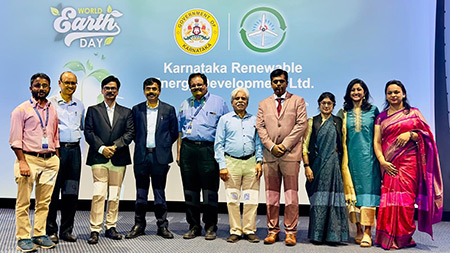
The NMIT Green Hydrogen Research Team participated in the "World Earth Day" event, themed around green hydrogen energy, held on April 22, 2024. This event was organized by UDJAN in collaboration with Karnataka Renewable Energy Development Ltd. (KREDL) and NMIT. During the event, the NMIT team showcased their cutting-edge hydrogen research. The team comprised Dr. K.B. Rao, Prof. M.S. Thakur, Prof. P.N. Tengli, Dr. K. Manjunath, Prof. Sandeep Kumar and several Research Associates.
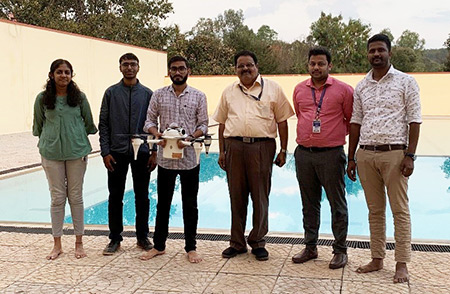
Fund granted for "Experimental and Analytical strength investigation of Repaired FRP Laminates" by KSCST 2024.
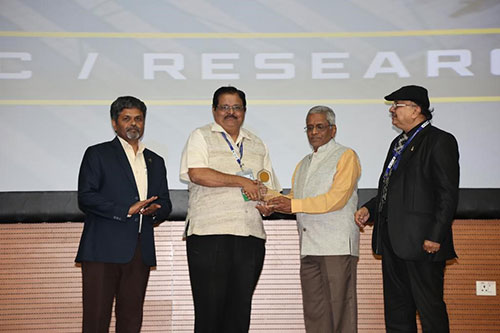
Dr P N Tengli, Professor, Department of Aeronautical Engineering has received the Research and Academic Excellence Award from HMA (HAL Management Academy) Bangalore on 21st January 2023.
Student Achievements
- NITTE (Deemed to be University), Nitte Meenakshi Institute of Technology (NMIT), Bengaluru, successfully demonstrated a Hydrogen Fuel Powered Unmanned Aerial Vehicle (UAV) on 8 July 2026. For the first time in India, hydrogen powered all onboard flight systems, significantly enhancing drone endurance. This proof of concept demonstrates the potential of replacing conventional batteries with clean hydrogen fuel cells. The project was developed at the R&D Centre, Department of Aeronautical Engineering, NMIT, under the guidance of Dr. P. N. Tengli, Professor & Head, R&D (Defense & Aerospace), with the support of faculty and students.
- The student team from the Department of Aeronautical Engineering, NITTE Meenakshi Institute of Technology (NMIT), Bengaluru, secured 1st Place in the Aeromodelling Competition at the Technoxian World Robotics Championship, held on 20 July 2026 at SRM University, Chennai.
- Team Members:Mohammed Abdul Kareem, Affaan Ahmed, Abhayy Venkatesh, Siv Kiran G., Siddharth Maddur, Mokshith Sharma T.P., Meher Chaitanya, A. Mahilan, Kushi P.S. and Sniti Jain.
- The Department of Aeronautical Engineering participated in the PALS Annual Meet 2026 at the IC&SR Building, IIT Madras, Chennai, as an invited stall exhibitor under the Centre for Robotics and Aerospace Research. The department showcased two educational robots, a hydrogen fuel-powered drone, and an amphibious drone. The exhibits received wide appreciation from visitors, and the team was honoured with a Special Prize for Exceptional Participation, strengthening the department's visibility and promoting academic and industry collaborations.
- The NMIT AIAA Student Chapter of the Department of Aeronautical Engineering has secured First Place at the prestigious Ignitia Aerofest 2026, hosted by KCG College of Technology on 11th April 2026.
- The Department of Aeronautical Engineering secured sponsorship approval for two student projects—“Design and Optimization of Flexible Propeller for MAV Application” by Chinna Kavya, Aamina Tabassum, and Bhargavi D under the guidance of Mr. Deepak Kumar and Dr. Jini Raj, and “Development of Next-Generation Bio-Inspired Morphing Leading-Edge Tubercles of Wings to Enhance Fuel Efficiency and Maneuverability in Unmanned Aerial Vehicles” by Chaithra K, Aditi Abhilasha, and H.R. Ankitha under the guidance of Dr. Jini Raj R—each receiving a grant of ₹6,000 in recognition of their innovation and technical excellence.
- The Vyoma Multidisciplinary UAV Club of the Department of Aeronautical Engineering secured First Prize in the prestigious IIT Madras–Boeing Competition, along with an internship opportunity at Boeing. The achievement was accomplished by the team members Murthan, Jesto, Sai, and Delisha, reflecting their exemplary performance and technical excellence.
- The Vyoma Multidisciplinary UAV Club secured Second Place in the National Aeromodelling Competition conducted by the Indian Academy of Aerospace and Aviation (IAAA) at the Velammal Bodhi Campus. The team comprised Murthan (Aeronautical Engineering), Dhruv (B.Sc. CAPT), and Varshitha (Aeronautical Engineering).
- Mr. Indrajith G. A. has successfully published a Design Patent titled “Detachable Fuselage Integrated with Docking Mechanism for Emergency Aircraft Survivability.” The work was carried out under the guidance of Dr. Somashekar V., reflecting a significant contribution to innovation in aircraft safety and survivability systems.
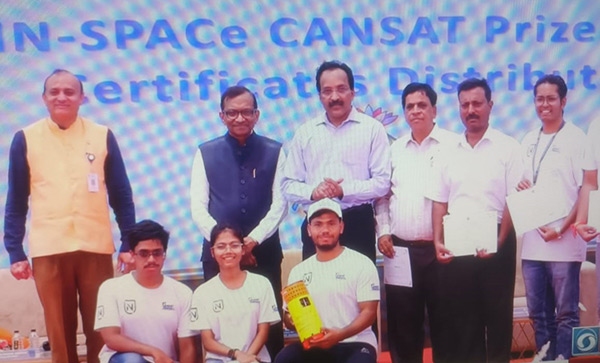
- NMIT team of Model Rocketry and CANSAT launched their Model Rocket from launch site at Tumhi Raj, Kushinagar, UP. The student team was supposed to clear 3 rounds of review before the launch and the team passed all the reviews without any corrections in the design.
- A team comprising T. Nithin (4th Year, Aeronautical Engineering), Soumya Sunil (4th Year, Aeronautical Engineering) and Murthan Ashok (2nd Year, Aeronautical Engineering) secured the First Place in the Ethereal Exploration – RC Plane Event (75+ RC Plane Category) at CONSCIENTIA 2025, the Annual Technical Festival organized by the Indian Institute of Space Science and Technology (IIST), Thiruvananthapuram.
- Team VYOMA Excels at PRAVRUTTI 2025 The Multidisciplinary UAV Club – VYOMA demonstrated exceptional technical expertise and innovation at PRAVRUTTI 2025, the National Tech Fest organized by MS Ramaiah University of Applied Sciences, Bengaluru, held from 15th to 17th October 2025.
- The team achieved outstanding success across multiple national-level events, securing top positions and impressive cash prizes.
- In the Micro RC Event, Soumya Sunil and Krithi Suvarna (4th Year, Aeronautical Engineering) won First Place with a prize of ₹20,000.
- In the Windrush Event, Tejas V. G., Madan L. N. and Sourav Kori (3rd Year, Aeronautical Engineering) bagged Second Place, winning ₹15,000.
- Additionally, Dhruv Gopal Devali, Shreekasha U. Shetty, Lahari H. Prasad and Murthan Ashok (2nd Year, Aeronautical Engineering) secured Third Place, receiving ₹5,000.
- Seven student project proposals from Department of Aeronautical Engineering got approved for sponsorship in the 48th series of Student Project Programme (SPP) by Karnataka State Council for Science and Technology.
- A team of students—Manu Shaji, Moorthan, Eby Francis, Kusumitha and Ganesh Prasad—from the Vyoma Club, Aeronautical Engineering Department, secured 3rd place in the zonal round of the prestigious Boeing National Aeromodelling Competition held at IIT Madras on January 25–26, 2025. The team was awarded a cash prize of ₹20,000. The competition was guided by faculty coordinators Dr. Jini Raj R and Mr. Deepak Kumar P.
- Team Speedbird, representing Club Vyoma from the Aeronautical Engineering Department, secured 3rd place in the competition on Advances in Drone Technology held at Jain University's Global Campus, Bangalore, on October 25th and 26th, 2024.
- The project titled "Experimental and Analytical Strength Investigation of Repaired FRP Laminates," done by Mr. Shashi Kumar S, Ms. Pragathi B S and Mr. Shree Naresh, guided by Mr. Ramvishal G and mentored by Dr. Srikanth H. V, has been selected for the State Level Poster Presentation in the 47th series of the Student Project Programme (SPP) for 2023-24. This project, bearing the reference number 47S_BE_3284, is sponsored by the Karnataka State Council for Science and Technology. The research focuses on evaluating the strength and durability of repaired Fiber-Reinforced Polymer (FRP) laminates through both experimental and analytical methods. The aim is to understand the effectiveness of repair techniques and their impact on the structural integrity of FRP materials, which are widely used in various engineering applications due to their high strength-to-weight ratio. The selection of this project for the state-level presentation underscores its significance and the potential contributions it could make to the field of materials engineering.
- Ms. Shambhavi, the topper and gold medallist of the first batch of M.Tech in Defence Technology, received her M.Tech certificate from VTU/NMIT.
- The Aeronautical Society of India, in collaboration with IN SPACE (the technical unit of ISRO) and the Indian Space Research Organization (ISRO), organized a competition for engineering college students across India. The competition aimed to design, fabricate, test and launch a satellite using commercially available components. Students of NMIT from the Departments of Aeronautical Engineering and at Electronics and Communication Engineering built the NMIT SAT for this event. The team successfully defended several critical evaluations, including the Preliminary Design Review, Critical Design Review, Mission Readiness Review and Flight Readiness Review. Meeting all these requirements, the NMIT SAT was launched on April 16, 2024, from Ahmedabad. The satellite reached an altitude of 3000 feet, after which it was ejected and began its descent at a velocity of 10 meters per second. Upon reaching 2000 feet, a second parachute deployed, slowing the descent to 3 meters per second. The satellite ultimately landed approximately 800 meters away from the ground station. All data from the satellite's payload, including temperature, pressure, gas constituents, altitude and camera footage, were successfully received at the ground station. The gyro control unit, control system module, descent control parachute and ground station for data transmission and reception were designed by the students of NMIT. The team's efforts were commended by the Chairman of ISRO, the Chairman of the technical unit of ISRO, the Principal of NMIT and the Administrator of NMIT
The students of Aeronautical Engineering - Prathik N, Vaibhav Padmashali, Meghana S and Shamanth S Acharya, exhibited the project titled "structural evaluation of aero engine blisk" in the second national level inter college project competition "DBIT TEXPO-2022" organised by the dept of research and development, DBIT-Bangalore in association with Karnataka state council for science and technology & Karnataka science and technology academy, Govt of Karnataka held on 20th July 2022.
Sheetal R of 5th sem secured 2nd position, at MechAura, Women Engineers, conducted by Collins Aerospace, during December /Jan 2023. She has received paid Internship from Collins Aerospace.
Under the guidance of Dr. M S Thakur, Pooja and team Won 3rd prize, in the All-India National Competition organized by Ramaiah College of Engineering. Defended three rounds and won the third prize among 50 participants. Displayed the work on Biosensors for Pesticides.
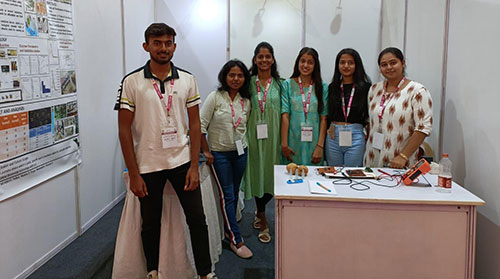
Shambhavi A S, received a Scholarship Award of Rs.3.72 Lakhs from Defence Research and Development Organisation (Ministry of Defence), DRDO, NEW DELHI.
Shambhavi A S won the Best paper award titled "Counter Space Proficiencies for International Space Security" in the SMOPS 2023 Conference by ISRO, IAA, ASI
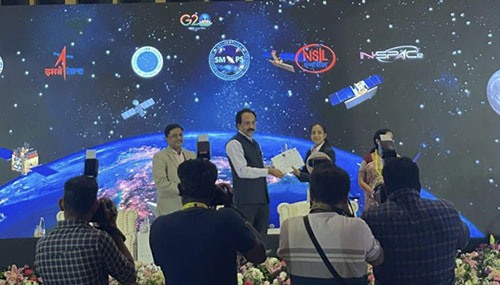
Excellent performance in GATE
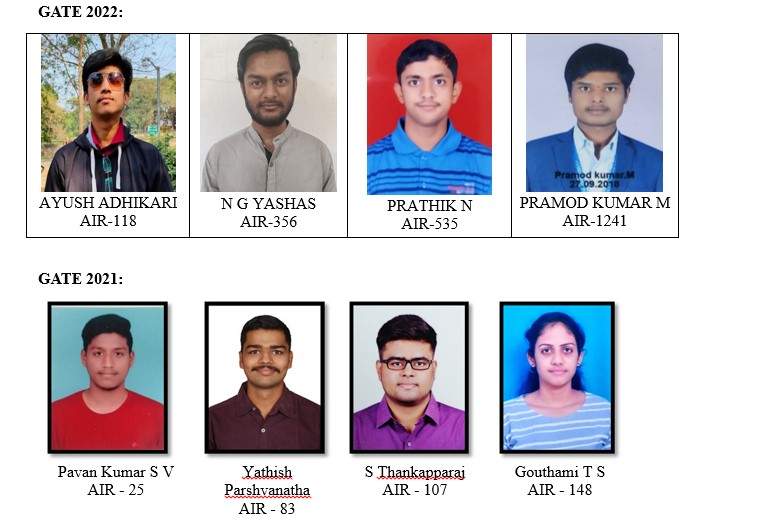
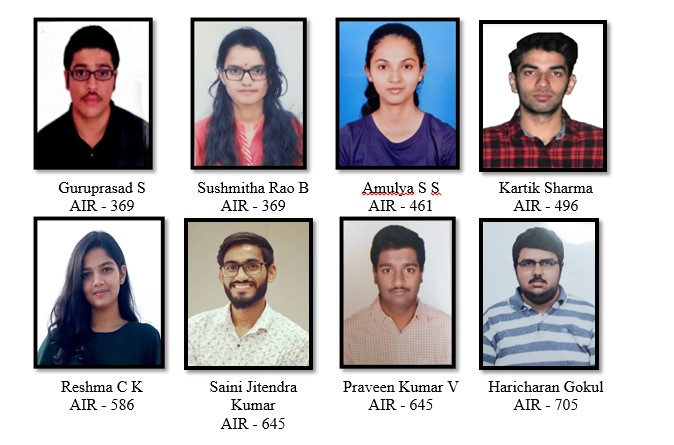
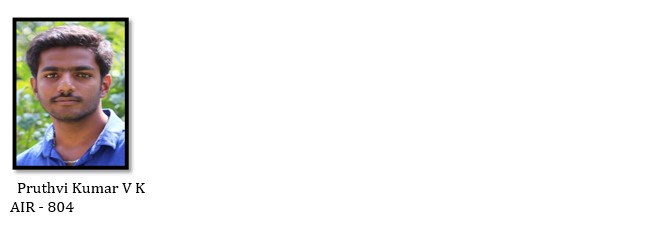
MAD (Model Aircraft Design) challenge 1.0
Barath Kumar V, Rishav Rakesh, Anirudh P and Mahendra Sujay Kurdekar have designed, fabricated and flown an airplane model s under the guidance of the faculty Mr. Prashant Manvi and won 3rd place in the competition MAD (Model Aircraft Design) challenge 1.0 conducted by Sri Ramakrishna Engineering College (SREC), Coimbatore.
The Department of Aeronautical Engineering inaugurated the Aeronautical Society of India (AeSI) Student Chapter. The event featured the introduction of the student committee and the official logo release, symbolizing the chapter’s vision to bridge academic learning with aerospace industry engagement. This initiative aims to foster technical excellence, research culture and professional development among students in the field of aeronautics.
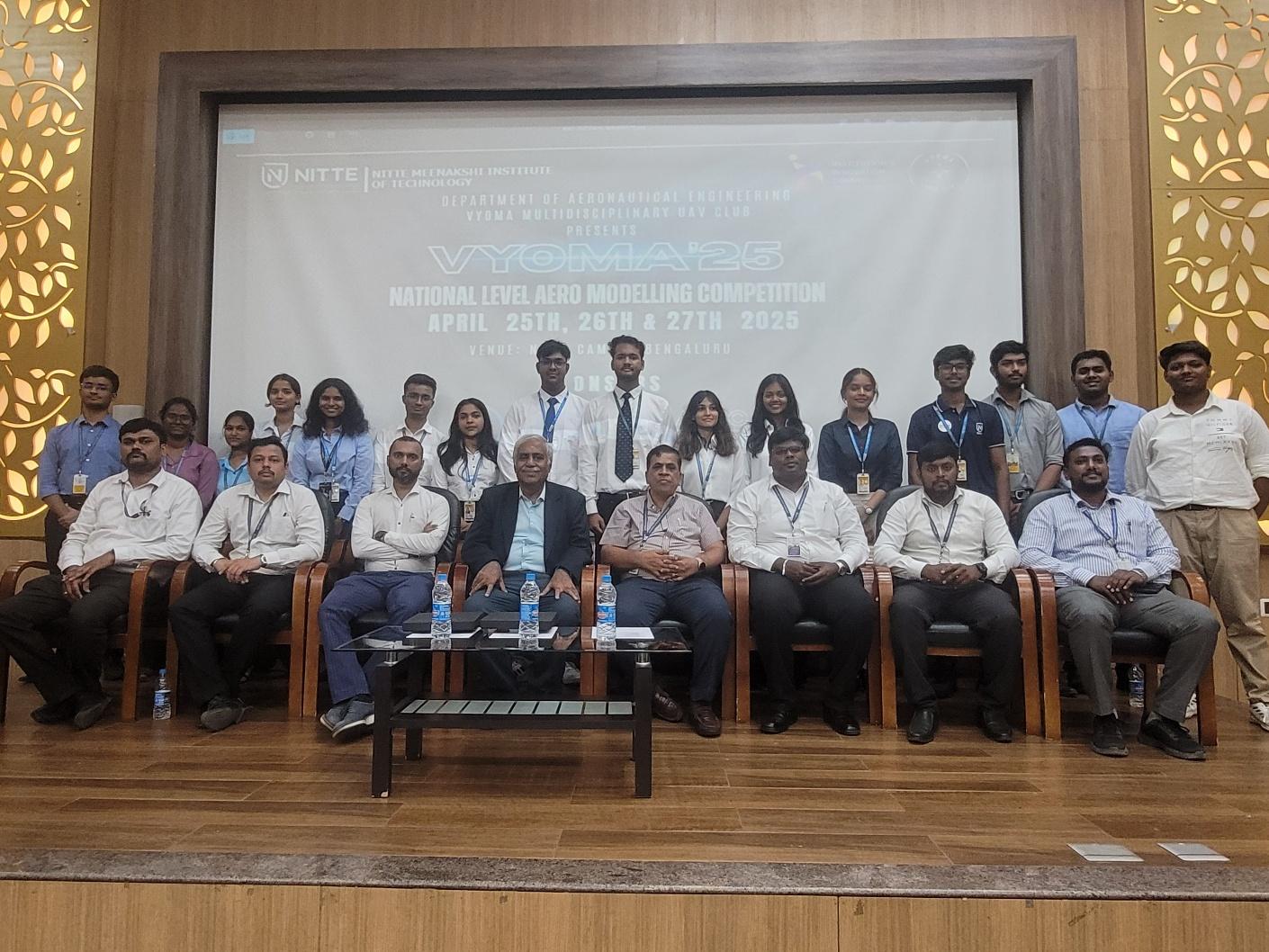
Multidisciplinary UAV Club:
‘The Multidisciplinary UAV Club, dedicated to the design and development of UAVs, was officially launched, providing Aeronautical Engineering students with a unique hands-on learning opportunity.
FALCON’ the Aeronautical Students’ Association NMIT
‘FALCON’ the Aeronautical Students’ Association NMIT, which is named after a bird called the falcon, was started in the year 2014 by the students of Aeronautical Engineering. FALCON organises the co-curricular, extracurricular activities to develop the interpersonal and intrapersonal skills of students. It organises seminars, workshops, quizzes, programs, industrial visits, guest lectures, career guidance and aeromodelling under its auspices. It is an exciting place where the faculty is friendly, well qualified and able to provide an excellent, supportive environment for the students to study.
‘AIAA’ Students Chapter
Department of Aeronautical Engineering NMIT has been successful in setting up the student chapter of AIAA, USA under the guidance of faculty advisor Dr. Vinayaka N. NMIT is the 1st Institute from Karnataka and 4th Institute from India who have been successfully in setting up this chapter. The American Institute of Aeronautics and Astronautics (AIAA) is a professional society for the field of Aerospace Engineering and is the world's largest Aerospace technical society. It helps us to participate, organize and achieve at international level.
Industry Interaction
Innovate, Create,
Engineer
Industrial Visit to Trinity NDT
An Industrial Visit to Trinity NDT was organized for students of the Aeronautical Engineering Department on 26 August 2026. The visit provided students with practical exposure to Non-Destructive Testing (NDT) techniques and their applications in industrial inspection and quality assurance. The interaction with industry professionals helped students understand real-world testing procedures and the importance of NDT in ensuring the safety and reliability of aerospace and engineering components.
Industrial Visit to National Institute of Wind Energy, Kayathar and Vikram Sarabhai Space Centre (VSSC-ISRO), Thiruvananthapuram
The Department of Aeronautical Engineering organized an Industrial Visit to the National Institute of Wind Energy (NIWE) and the Vikram Sarabhai Space Centre (VSSC) from 14 April 2026 to 18 April 2026 for second- and third-year students. A total of 76 students participated in the visit.
The visit offered students a unique opportunity to explore renewable energy systems, aerospace technologies, and space research facilities. They gained firsthand insights into wind energy generation, propulsion systems, launch vehicle technologies, and other advanced engineering applications. The experience provided valuable industry exposure, bridging the gap between classroom learning and real-world engineering practices.
Visit to Visvesvaraya Industrial and Technological Museum
The Second-Year students visited the Visvesvaraya Industrial and Technological Museum, Bengaluru, on 07th February 2025 as part of a co-curricular activity. The visit provided valuable exposure to engineering principles, scientific innovations, and technological advancements through interactive exhibits and demonstrations.
Visit to Indian Manufacturing Show 2025
On 07 November 2025, third-year Aeronautical Engineering students and first-year Defence Technology (PG) students participated in an industrial visit to the Indian Manufacturing Show 2025 at the Bangalore International Exhibition Centre (BIEC), gaining exposure to the latest advancements in manufacturing technologies and industry practices.
Visit to AISEL Mumbai
Third-year students undertook an academic–industrial visit to AI Engineering Services Ltd. (AISEL) from 14 to 16 January 2026 as part of their industry exposure and experiential learning initiative. The visit effectively bridged classroom learning with real-world industrial practices, enriching students’ understanding and enhancing their awareness of professional standards within the aviation and aerospace sector.
The visit to the Indian Institute of Astrophysics (IIA) on November 29, 2024, was an enriching experience, offering profound insights into cutting-edge astrophysics research and the advanced technologies driving modern astronomy. It provided valuable exposure to the latest advancements in space science, telescope design and data analysis techniques.
Visit to Alpha Tocol Engineering Services Limited
On July 4, 2024, a group of students visited Alpha Tocol Engineering Services Limited, gaining valuable insights into real-world engineering practices. The visit included a comprehensive tour of the facility, where students observed advanced engineering processes and cutting-edge technologies. They explored various production stages and quality control, deepening their understanding of the complexities involved in engineering services. Interacting with experienced professionals, the students received expert guidance and inspiration, which enriched their grasp of engineering concepts and motivated them to strive for excellence in their future careers.
Visit to the U.R. Rao Satellite Centre (URSC)
On April 23, 2024, students participated in a technical visit to the U.R. Rao Satellite Centre (URSC) to learn about various classes of satellites and their manufacturing processes.
Visit to AERO INDIA 2023
The Department of Aeronautical Engineering arranged a visit to AERO INDIA 2023 for the students of 3rd and 4th year in February 2023 at Airforce Station, Yelahanka Bengaluru to witness the operations and manoeuvres of Combat Aircrafts, LCA, Helicopters such as, LCA Tejas, Rafale, Sukhoi, F 35, Sarang, MIG 29, Surya Kiran etc.,
Industrial Visit at Satish Dhawan Space Center- SHAR
Fourth Semester students and Faculty members of the department visited Space Port of India (SDSC - SHAR Satish Dhavan Space Centre Sriharikota Range) as a part of an Industrial visit on 15th June 2022. Space museum and Space launch activities such as Launch countdown, launch and tracking of Launch vehicle are demonstrated in SDSC SHAR facility for the students
Visit to INS HANSA, Naval Base, Goa
Team of students of 3rd Year had the opportunity to visit INS HANSA, Naval Base, Goa in June 2022.
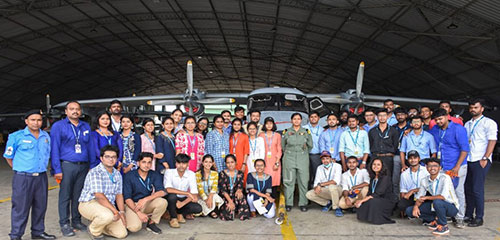
Industrial Visit to IDSN, ISRO Bengaluru
The students of Department of Aeronautical Engineering visited Indian Deep Space Network (IDSN), ISRO Bengaluru on 30th January 2023. IDSN consists of three large antennas for supporting communications with space science and planetary exploration missions of the Indian Space Research Organization (ISRO).
Industrial Visit to HAL
PG students visited Hindustan Aeronautics Limited (Foundry and Forge Division) Bangalore in May 2023. The Foundry & Forge Division manufactures Castings, Forgings, Rolled Rings, Shape Memory Alloy Products, Brake pads and Rubber Products for critical applications such as Aeronautics, Space, Defense.
Flight Training Program March 2023- IIT Kanpur
The Department of Aeronautical Engineering has created a very good opportunity for the students of the 3rd and 4th year by organizing a visit to the IIT Kanpur for Flight Training Program from 13th to 22nd March 2023. During this training, students conducted various experiments using airplanes to determine different design and performance parameters. The airplanes used for experiments are: Cessna 206H, Piper Saratoga and NAL Hansa.
Seminar on Career Opportunities
The department of Aeronautical Engineering in association with AECC Global organised a seminar on Career Pathway and Study Abroad Opportunities on 20th October 2022.
The department of Aeronautical Engineering in association with AECC Global organised a seminar on Career Pathway and Study Abroad Opportunities on 20th October 2022.
5th Semester Students visited NDT TRINITY, Bangalore on 10th January 2023. Students got the hands-on experience on experiments in NDT, like Radiography (X-ray) Ultrasonic Testing (UT), Magnetic Particle Testing (MPT), Penetrate Testing (PT), Eddy Current (ET), Visual Testing (VT).
The Department of Aeronautical Engineering has forged meaningful partnerships with a range of esteemed organizations, each contributing to the holistic development and academic enrichment of students.
- Airports Authority of India (AAI) - A Memorandum of Understanding (MoU) was signed with the Airports Authority of India (AAI) in July 2025 for a period of five years. This MoU facilitates internship and field visit opportunities for students, providing valuable industry exposure and practical insights into airport operations, air traffic management and aviation infrastructure. The collaboration aims to strengthen the institute–industry interface and enhance students’ experiential learning in the field of aerospace and aviation.
- HFCL Limited – Department of Aeronautical Engineering signed an MOU with HFCL Limited on 27th November 2024. This strategic partnership aims to foster collaboration in research, innovation and skill development, bridging the gap between academia and industry.
- Multiplex Drone Private Limited Department of Aeronautical Engineering, NMIT has signed an MOU with Multiplex Drone Private Limited, Bangalore on 15/07/2024. The tie up will help the students to undergo Projects, Internships, Placements in the department.
- National Aerospace Laboratory Bangalore, CSIR Lab, Govt of India and NMIT, signed an MOU fostering collaboration in aerospace research and technology development.
- Namrata Hemco collaborates with NMIT on a Natural Fiber Funded Project by DRDO, providing industrial support and supplying natural fibers to NMIT.
- M/S IND-LAB EQUIPMENTS PVT. LTD. in Bangalore stands as a cornerstone for the department's practical education, offering vital services in the purchase and maintenance of laboratory equipment. This collaboration ensures students have access to state-of-the-art tools, fostering hands-on learning experiences.
- Capgemini Technology Services India Limited, headquartered in Pune, spearheads the department's career readiness initiatives. Through placement training programs and internship opportunities, students are equipped with the skills and experiences necessary to thrive in the competitive job market.
- Dassault System's involvement adds a cutting-edge dimension to the department's curriculum. With internships for students and a funded project focusing on drone technology, students have the chance to engage with advanced aerospace technologies, preparing them for future industry challenges.
- Z-MOTION AUTONOMOUS SYSTEMS contributes to curriculum design, ensuring that the program remains relevant and up-to-date with industry standards, thus enhancing the quality of education imparted.
- Vijay Cad/Camm Solutionz, based in Bangalore, provides invaluable internship opportunities, allowing students to apply theoretical knowledge in practical settings, bridging the gap between academia and industry.
- BRNO University of Technology, Czech Republic The partnership facilitates enriching student and faculty exchanges, fostering a global perspective and cross-cultural collaboration within the department.
- Erisha Space Private Limited offers internship opportunities, enabling students to delve into the exciting realm of space technology.
- Bengaluru Aircraft Industries Private Limited contributes to curriculum design and the delivery of specialized electives, further enhancing students' expertise in aeronautical engineering.
- Vinsum Global Solutions rounds off the collaboration spectrum by delivering specialized courses like 'Hyperworks,' enriching students' skill sets under the guidance of industry experts.

Placements
Graduates from the B.E. Aeronautical Engineering program at Nitte Meenakshi Institute of Technology, Bengaluru, have secured positions in leading and esteemed companies within the Aeronautical domain. Some notable organizations include DRDO, CSIR-NAL, Air India, Boeing, Lufthansa, Quest Global, Collins Aerospace, Acumen, Aero Platina Technologies, Capgemini, Infosys, Cognizant, Tech Mahindra, Garuda Aerospace, Accenture, Alten and more.
























Dr. Srikanth H. V
- Designation Professor & Head
- Email srikanth.hv@nmit.ac.in
- Contact No.
- Joining date 2013-08-19
BE, M. Tech, Ph.D
10+ Years
Bio fuels
Thermal Engineering
Aerodynamics
Machine Learning
Aero Engineering Thermodynamics
Fluid Mechanics
Aircraft Materials & Manufacturing
Rocket Propulsion
Research Methodology & IPR
Turbo machines
Heat and Mass transfer
Non-destructive testing
1. Funded project titled "To study the effect of pressure oscillations in a Solid Rocket Motor using CFD", sanctioned by ARDE, Pune, 2020-21.
2. Seed Money for research titled "Study on Production and Characterization of Biodiesel Derived from Plant and Animal Origin" sanctioned by NMIT, Under TEQIP-II,2016-17.
3. Funded project titled "Experimental and numerical on the performance of Eppler airfoil for low Reynolds' number flows" sanctioned by KSCST, 2017-18.
4. Funded project titled "A study on heat transfer characteristics of a gas turbine blade by thermal barrier coating" sanctioned by KSCST, 2019-20.
5. Funded project titled "Enhancement of Aerodynamic characteristics of Airfoil" sanctioned by KSCST, 2015-16.
6. Funded project titled "A study on crystallization properties of biodiesel and improving with cold flow improvers" sanctioned by KSCST, 2014-15
ORCID ID: https://orcid.org/0000-0001-7191-9100
Google scholar: https://scholar.google.com/citations?user=QFxI4O8AAAAJ&hl=en
LinkedIn Profile: https://www.linkedin.com/in/dr-srikanth-h-v-05465127/
Abhishek T K
- Designation Assistant Professor
- Email abhishek.tk@nmit.ac.in
- Contact No.
- Joining date 2022-07-03
B.E, M,Tech
5+ years
Aerodynamic, CAD, CFD, Aircraft performance stability and control.
- Aerodynamics
- CFD
- Aircraft stability and control
- Airspace engineering
- Helicopter dynamics
- Aircraft system and instrumentation
- Wind tunnel theory
- Flight Mechanics
Swarm Technology
Google Scholar ID: https://scholar.google.com/citations?user=KH2uE_kAAAAJ&hl=en
ORCID ID: https://orcid.org/0000-0002-8103-3845
LinkedIn Profile: https://www.linkedin.com/in/abhishek-t-k-0710bb192/
Group Captain. C A Somiah (Retd)
- Designation Professor
- Email chodumada.aiyanna@nmit.ac.in
- Contact No.
- Joining date 2022-08-30
BE Mech, ME Mech, Aeronautical Engineering (AFTC), MDBA(Personnel)
Courses: MiG 27 Aircraft (TETTRA), Networking (IIT Kharagpur),
Financial Management (IIM Bangalore), Global Supply Chain Management (IIFT
Delhi)
33+ years in the industry and 9 years in academics (Chief of Air Staff Commendationrnand Appreciation letters from Indian Air Force, HAL, and DRDO)
Aeronautical Engineering Issues and Topics
Aircraft Performance and Stability, Non Destructive Testing, Aircraft Servicing & Maintenance Safety
MiG 27 Air Frame Life Extension
Pilot Parachutes Evaluation and Life Extension
SU 30 Bearing Studies
MiG 21 Flame Out Studies Inquiries on incident/ Accident on MiG27
Dr. Deenadayalan K
- Designation Assistant Professor
- Email deenadayalan.k@nmit.ac.in
- Contact No.
- Joining date 2024-05-10
PhD
Teaching: 5+years,
Research: 6 years
Industry: 1 year
Surface Engineering, Coatings & Nickel based Superalloys
Fluid Mechanics, Incompressible Aerodynamics, Finite Element Methods, High Temperature materials, Unmanned Aerial Vehicles
Google Scholar ID: https://scholar.google.com/citations?view_op=list_works&hl=en&user=87BRvqsAAAAJ
ORCID ID: https://orcid.org/0000-0002-1275-6599
P. DEEPAK KUMAR
- Designation Assistant Professor
- Email deepak.kumar@nmit.ac.in
- Contact No.
- Joining date 2023-12-12
B.E.,
M.Tech
5+ Years
Aerospace propulsion,
Aircraft systems and maintenance
Aerospace Propulsion,
Advance Propulsion,
Aero Thermodynamics
Google Scholar ID: https://scholar.google.com/citations?hl=en&user=BoFSZV4AAAAJ
ORCID ID: https://orcid.org/0000-0002-7189-0237
LinkedIn Profile: https://www.linkedin.com/in/deepakkumarpandiyan/
Fareen Nizami
- Designation Assistant Professor
- Email fareen.nizami@nmit.ac.in
- Contact No.
- Joining date 2022-12-16
B.E, M.Tech
1+ Years
Aerothermodynamics, Aerospace Propulsion
Aerothermodynamics, Aerospace Propulsion, Propulsion Lab, Aircraft Maintenance & Repair, Aircraft Maintenance & Practice, Aerodynamics Lab, Technical Authoring In Aircraft Manuals, Grid Generation Using A Meshing Software Tool, Introduction to Mechanical Engineering, Biology for Engineers.
Funded project titled "Design, Analysis & Weight Optimisation of Hydrogen Fuel Cell for Long Endurance UAV" sanctioned by KSCST, 2024-25.
ORCID ID: https://orcid.org/0009-0001-5796-9010
Research Gate Profile:https://www.researchgate.net/profile/Fareen-Nizami
GoogleScholar:https://scholar.google.com/citations?hl=en&user=4FwdroUAAAAJ
G Narahari Datta
- Designation Professor & Scientific Officer
- Email narahari.datta@nmit.ac.in
- Contact No.
- Joining date 2021-07-07
B.E, M.E(Space Engineering & Rocketry), MBA
4 years in teaching and 35 years in Industry
Rocket Propulsion, Vehicle Design, Antenna design, Satellite communication, Satellite fabrication, testing and Launching, Navigation, Guidance and Control area.
One Patent and 6 ISRO Merit awards
Warfare Simulation and Strategy -PG
Guidance and Control - PG
Guidance Navigation and Control - UG
Two ISRO respond project under Final review
Two respond Project sanction total work of 45 lakhs and BEL Antenna design project cost 10 lakhs
Ram Vishal G
- Designation Assistant Professor
- Email ramvishal.g@nmit.ac.in
- Contact No.
- Joining date 2018-10-22
M.Tech, (Ph.D)
10+ Years
Aircraft Structures, Composite Materials
1. Project guided "Meso-Scale Analytical, FE Modelling and Validation of 3D Woven Fabric Composite" Won third prize in Project Expo-2021.
2. Project guided & Fund granted for "Investigation on Static and Dynamic Behaviour of 3D woven Hybrid carbon Aramid Epoxy Composite Laminate" by KSCST 2023.
3. Project guided & Fund granted for "Mechanical Behaviour of GLARE for Aerospace Applications" by KSCST 2023.
Structural Analysis & Detailed Design, Mechanical Vibrations and Structural Dynamics, Aircraft vehicle structures I & II, Experimental Stress Analysis, Composite Materials, Mechanics of solid, Engineering Mechanics, Aircraft Structure Lab, Flight Vehicle Design, Aircraft Structural Analysis Lab, Composite Lab
Development of Green Bio-composites for Ground Crew Helmets as a team member by DRBEL, DRDO.
Google Scholar ID: https://scholar.google.co.in/citations?user=c6V7V44AAAAJ&hl=en
ORCID ID: https://orcid.org/0000-0002-9228-0059
LinkedIn Profile: https://www.linkedin.com/in/gandham-ram-vishal-1b69a081/
Dr. JINI RAJ R
- Designation Assistant Professor
- Email jini.raj@nmit.ac.in
- Contact No.
- Joining date 2023-10-11
M.E, Ph.D
10+ years.
Bioinspired Aerodynamics, CFD, Low Speed Aerodynamics, High Speed Aerodynamics
Golden Award in QCFI chapter
- Aerodynamics-I & II,
- Gas Turbine technology,
- Advanced Propulsion,
- Aircraft Design,
- Fluid Mechanics,
- Thermodynamics.
Google Scholar ID: https://g.co/kgs/4C9vaJ

Dr. N.N. Kishore
- Designation Professor of Practice
- Email kishore.nn@nmit.ac.in
- Contact No. -
- Joining date 2024-10-07
B.E., M.Tech., PhD
40+ Years
Wave Mechanics, Composite Materials, Finite Element Methods and Boundary Element Methods Non-Destructive Evaluation, Dynamic Fracture Mechanics
FEM with MATLAB, Fatigue, Fracture and Creep
LinkedIn Profile: https://www.linkedin.com/in/nn-kishore-4a743555/
Dr. R. KOUSIK KUMAAR
- Designation Associate Professor.
- Email kousik.kumaar@nmit.ac.in
- Contact No.
- Joining date 2022-11-16
B.E, M.Tech, Ph.D.
10+ Years
Aircraft Structural Analysis, Composite Materials, and Structures, Finite Element Analysis, High-Temperature Materials, Materials Characterization
Recognized by The Academic Council of uLektz as one of the Top 50 Expert Faculties in the field of Electrical, Electronics, Civil, Mechanical & Aeronautical Engineering Across India for the year 2019.
Fluid Mechanics, IndustrialrnAerodynamics, Aerospace Materials (PG), Aircraft Materials and Manufacturing, Finite Element Methods, Composite Materials and Structures, AdvancedrnAerostructures, Aircraft Design and Analysis, Aircraft Design Project.
https://www.webofscience.com/wos/author/record/ADA-9125-2022
ScopusAuthorID:https://www.scopus.com/authid/detail.uri?authorId=57195204159
ORCID ID: https://orcid.org/0000-0001-6822-3719
ResearchrnGate Profile: https://www.researchgate.net/profile/Kousik-Kumaar-Rajagopal
Google Scholar id:https://scholar.google.com/citations?hl=en&user=Xo4MEpwAAAAJ
LinkedIn Profile: https://www.linkedin.com/in/dr-kousik-kumaar-rajagopal-bb51932b/
Mahantayya K Hiremath
- Designation Assistant Professor
- Email mahantayya.kh@nmit.ac.in
- Contact No. -
- Joining date 2025-07-02
M.Tech in Aeronautical Engineering (PhD -Aerospace engineering)
15 years
Aircraft Structures, Material Failure and Degradation and life evaluation.
Aircraft Structures, Flight vehicle design, Mechanics of Materials, Manufacturing process, composite materials, Finite Element methods and aircraft stability control.
Worked on "Investigation of effects and hazards of wind flow on buildings in multiple arrangements using CFD" as a Research Fellow
Google Scholar ID: https://scholar.google.com/citations?hl=en&user=AUwJX9EAAAAJ
ORCID ID: https://orcid.org/0009-0007-8866-1522
LinkedIn Profile: https://www.linkedin.com/in/mahantayya-hiremath-344570136/
Mahendra M A
- Designation Assistant Professor
- Email mahendra.ma@nmit.ac.in
- Contact No.
- Joining date 2024-06-03
B.E, MTech (PhD)
10+ Years
Composite Materials, Aircraft Structures
Best project of the year from Karnataka state council for Science and Technology (KSCST PROJECT) for project title "Design & Fabrication of Fixed Wing UAV for Agriculture application
Aircraft Structures-I, Aircraft Structures -II, Aircraft materials and digital manufacturing, Composite Materials, Mechanics of materials, Flight Vehicle design, Theory of vibrations labs Material Testing lab, Structures lab and Manufacturing lab
Title: Fabrication and characterization of advanced composite materials.
Funded by: Technical Education Quality Improvement Programme is a project of the Government of India assisted by the World Bank, Total cost Rsrn1,35,000 /-
Description: Design and development of Vacuum bag moulding process for fabrication of composite laminates, the FRP laminates so developed will pave the way for new avenues in the domain of research in composites. (Investigator)
Google Scholar ID: https://scholar.google.com/citations?user=sG_ZS3MAAAAJ&hl=en
ORCID ID: https://orcid.org/0000-0001-6678-5064
Mallappa Jabade
- Designation Assistant Professor
- Email mallappa.jabade@nmit.ac.in
- Contact No.
- Joining date 2022-12-14
B.E, M.Tech
5+ years
Aerospace Propulsion,
Advance Aerospace Propulsion
Introduction to Drone Technology
Python Programming
ORCID ID: https://orcid.org/0009-0007-4963-3019
Google Scholar ID: https://scholar.google.com/citations?user=IusXYwYAAAAJ&hl=en
Linkedin Profile: https://www.linkedin.com/in/mallappa-jabade-18a9a5216/
Dr. PRAHALAD N TENGLI
- Designation Professor
- Email prahalad.n@nmit.ac.in
- Contact No.
- Joining date 2019-07-15
Ph.D
38+ Years
Rocket Propulsion, UAV, Development and Testing Airframes
1. Lab Technology Group Award (2009) - Agni rocket motor processing by SA to RM (Ministry of Defence)
2. Special Award for Strategic Contribution (2011) - Processing and static testing of Agni-5 rocket motor successfully by the Hon'ble Prime Minister and Hon'ble Defence Minister
3. Certificate of Appreciation (2012) - Successful development and testing of the highest rocket motor processing for the Agni program. SA to RM (Ministry of Defence)
4. Award from Inner Wheel Club (2013) - Lifetime achievement for service to the Defence of India and recognition of defence contribution to Bastar academic institutes and universities.
5. Research and Academic Excellence Award from HAL, Management Academy, Bangalore, in the year 2023.
6. Funded Project execution award from NMIT, Bangalore two times in the year 2022 and 2023.
Systems Engineering & Analysis;
Organizational Behavior andrnFunctions;
Entrepreneurship & IPR;
Total Quality Management.
Sl No | Project Title | Funds Sanctioned In Rs |
1 | Design and Development of Amphibious Drone No: NSTL/CARS/BUILD-UP/2021-22/01 DATED: 03-03-2021 Organisation: NSTL, DRDO, Vishakhapatnam | Rs. 9,44,000/- |
2 | Design, Simulation, Fabrication, Packaging and Characterisation of MEMS based Sound Source Localizer for Gunshot events
Organisation: ARDE/ARMREB, DRDO, New Delhi | Rs. 24,04,512/- |
3 | Development of Signal Denoising and Processing Algorithm for Tip Clearance GTRE/MMG/BMR1/1014/22 CARS/A/22 DATED 27-06-2022 Organisation: GTRE, DRDO, Bangalore | Rs. 9,85,300/- |
4 | To simulate the effect of pressure oscillations of a solid propellant rocket motor using CFD and Its effect on rocket flight stability. No: ARDE/21CR0002/AERO & CFD/GN/CMS-III. Dated: 25/08/2020 Organisation: ARDE, DRDO, Pune | Rs. 9,48,999/- |
5 | Development of Green composites for Ground Crew Helmets No: LSRB/01/15001/LSRB-402/LS&BD/2023 Dated: 13-06-2023 Organisation: DEBEL, LSRB, DRDO, New Delhi | Rs. 42,70,127/- |
6 | Design and Development of an Innovative coordination platform for Swarm of Drones for autonomous flight capability. Organisation: Dessault Systems Pune | Rs. 22,00,000/- |
7 | "Production of Hydrogen from Sea water electrolysis using Photovoltaic / Wind energy hybrid systems using economically specialized membrane". No: MoE-STARS/STARS-2/2023-0293 Date: 26-09-2023 Organisation: Scheme For Transformational and Advanced Research In Sciences (Ministry of Education), Indian Institute of Science, Bangalore | Rs. 25,00000/- |
TOTAL | 1,42,52,938/- | |
Google Scholar_ID: http://scholar.google.co.in/citations?user=OCzYkQkAAAAJ
ORCID_ID: http://www.orcid.org/0000-0002-6896-7213
PRAVEEN N
- Designation Assistant Professor
- Email praveen.n@nmit.ac.in
- Contact No.
- Joining date 2023-08-23
M.Tech (PhD)
10 + Years
Flight Mechanics & Control, Control Systems, Avionics & Instrumentation
The speaker in the International APAC Virtual Workshop on "Teaching Computational Skills and Problem Solving with MATLAB and Simulink"
Avionics, Aircraft Performance, Control Systems, Guidance, Navigation and Control, Flight Mechanics, Aircraft Stability and Control, Aircraft Systems and Instrumentation, Fight Simulation Lab, Space Dynamics, Space Mechanics, Astrophysics, Astrodynamics
Google_Scholar_ID:_https://scholar.google.com/citations?hl=en&authuser=2&user=dnCubAQAAAAJ
ORCID ID: https://orcid.org/0000-0003-1058-3150
LinkedIn Profile: https://www.linkedin.com/in/praveen-n-0467758b/
Prashant Manvi
- Designation Assistant Professor
- Email prashant.manvi@nmit.ac.in
- Contact No.
- Joining date 2016-07-25
BE(Aero), M.Sc (Engineering) P.hd
10+ Years
Aircraft Materials
Fatigue
Composite Materials
Aircraft Stability & Control
Aircraft Performance
Airport Planning & Management
Aircraft Maintenance, Repair & Overhaul
Submitted a proposal on "Development of Ti6Al4V compressor stator vanes by Electron Beam Melting (EBM) additive manufacturing for Gas Turbine Engine application"
ORCID ID: https://orcid.org/0000-0001-9175-223X
Google ScholarID: https://scholar.google.com/citations?user=E81abg4AAAAJ&hl=en
LinkedIn Profile: https://www.linkedin.com/in/prashant-manvi-14586937/
POOJA CHAUBDAR
- Designation Assistant Professor
- Email pooja.chaubdar@nmit.ac.in
- Contact No.
- Joining date 2023-10-05
B. Tech (Aeronautical Engineering)
M. Tech (Aerospace Engineering)
5+ Years
Fluid Mechanics, Aerodynamics
Aircraft Performance, Propulsion, CFD
Google Scholar ID: https://scholar.google.com/citations?hl=en&user=Uqf0kCoAAAAJ
ORCID ID: https://orcid.org/0000-0003-4406-5482
RAHUL B
- Designation Assistant Professor
- Email rahul.b@nmit.ac.in
- Contact No.
- Joining date 2023-08-23
M.E.,
(Ph.D.)
5+ Years
- Fracture Mechanics
- Composite Materials
- Composite Materials
- Aircraft Structures
- Theory of Vibrations
- Control Engineering
- Avionics
- Theory of Plates and Shells
- Solid Mechanics
Google Scholar ID: https://scholar.google.co.in/citations?user=cXyn70QAAAAJ&hl=en
ORCID ID: https://orcid.org/0000-0001-6471-0018
Dr. Rajadurai M
- Designation Associate Professor
- Email rajadurai.m@nmit.ac.in
- Contact No.
- Joining date 2021-11-15
BE, ME, PhD (VIT-Vellore)
10+ years
- Aircraft Structures
- Materials
- Finite Element Analysis
- UAV
1.Reward received for the research contribution, Nitte Meenakshi Institute of Technology, 2022.
2.Awards Received, India Innovation Challenge Design Contest Award issued by DST and Texas Instruments, 2018.
Introduction to Aerospace Engineering
Strength of Materials
Aircraft Structures
Composite Materials
Finite Element Analysis
UAV
Web of Science Researcher ID: S-3237-2017
Scopus Author ID: 57195607409
ORCID ID: 0000-0002-0833-318X
Research Gate Profile: https://www.researchgate.net/profile/Rajadurai-M-2
Google Scholar Id: https://scholar.google.co.in/citations?user=Y3JSmyAAAAAJ&hl=en
LinkedIn Profile: https://www.linkedin.com/in/dr-rajadurai-m-3553aa24/
Dr. SAMBHAJI SHIVAJI LORE
- Designation Assistant Professor
- Email sambhaji.sl@nmit.ac.in
- Contact No.
- Joining date 2022-07-07
B.Tech.
(AeSI), M.Tech. (IIT Kharagpur), Ph.D. (IIT Kharagpur)
5+ years
- Composite Structures
- Non-linear Analysis
- Uncertainty Quantification
- Reliability Analysis
- Finite Element Methods
- Surrogate Methods
- Artificial Intelligence
Aircraft Design and Analysis
Aerospace Structures
Google Scholar ID: https://scholar.google.com/citations?user=bZc6YDkAAAAJ&hl=en
Scopus Author ID: https://www.scopus.com/authid/detail.uriauthorId=57203853268
ORCID ID: https://orcid.org/0000-0002-1380-5698
ResearchGate Profile: https://www.researchgate.net/profile/Sambhaji-Lore
LinkedIn Profile: https://www.linkedin.com/in/dr-sambhaji-lore-ab4213106/
Dr. Siddalingappa P Kodigaddi
- Designation Assistant Professor
- Email siddalingappa.pk@nmit.ac.in
- Contact No.
- Joining date 2015-01-19
B.E., M.Tech., Ph.D.
10+ Years
Aerodynamics, CFD, UAV
Best Presenter Award in the 3rd International Conference on Emerging Research in Civil, Aeronautical and Mechanical Engineering held on 16th -17th December at NMIT Bengaluru.
Design Report of an Electric Motor-Powered Radio Controlled Heavier-than-air Model Aircraft and own 2ndplace in 'Best Design Report Award' in Regular Class SAEINDIA Southern Section "AERO Design Challenge" held from 19th to 21st July 2019 at SRMIST Chennai.
Aerodynamics 1 & 2
Industrial Aerodynamics
Advanced Aerodynamics
Wind tunnel Techniques
Flight Testing
Aircraft Engineering & Design
Material Science & Metallurgy
Aerodynamics Lab
Flight Physics Lab
Computer Aided Engineering Drawing Lab
Manufacturing Process lab
- Design and Development of Amphibious Drone, funded by Naval Science & Technological Laboratory (NSTL), DRDO, Visakhapatnam – ₹9.44 Lakhs (Co-PI, Completed).
- Design and Development of Swarm Drone with Ground Control Station, funded by NMIT Seed Fund – ₹3.00 Lakhs (Co-PI, Completed).
- Design and Development of an Innovative Coordination Platform for Swarm of Drones, funded by Dassault Systèmes – ₹22.00 Lakhs (Co-PI, Completed).
- Design and Development of Amphibious Drone, funded by AICTE Yukti 2.0 – ₹5.00 Lakhs (Co-PI, Ongoing).
- Design and Development of a Stealth, Reduced-Noise, Long-Endurance Image Detection Drone for Surveillance Applications, funded by NMIT Seed Fund – ₹2.50 Lakhs (Co-PI, Completed).
- Lightweighting and Optimization of Hydrogen Fuel Cell for Flight Endurance of Unmanned Aerial Vehicle, funded by Dassault Systèmes – ₹9.00 Lakhs (Co-PI, Ongoing).
- Comparison of Mixing Phenomenon and Flow Patterns in Two-Blade and Three-Blade VPM, and Scale-Up Modeling for Predicting Mechanical Properties and Viscosity, funded by Advanced Centre for Energetic Materials (ACEM), DRDO, Nashik – ₹9.52 Lakhs (Co-PI, Ongoing).
Total Research Funding Involved: ₹60.46 Lakhs.
Web of Science Researcher ID: ADE-3929-2022
Scopus Author ID: 57210597356
ORCID ID: 0000-0001-5712-4555
Research Gate Profile: https://www.researchgate.net/profile/Siddalingappa-Pk
Google Scholar Id : 5Vz7Y-0AAAAJ&hl
LinkedIn Profile: https://www.linkedin.com/in/siddalingappa-p-kodigaddi-a5928789/

T. Sreelakshmi
- Designation Assistant Professor
- Email sree.lakshmi@nmit.ac.in
- Contact No. -
- Joining date 2025-06-26
B.E, M.Tech in Aerospace Propulsion Technology
5+ years
- Fluid Mechanics
- Aerodynamics
- Structures
- FEA
- Performance
- Ansys
- CADD
- Fluid Mechanics
- Aerodynamics
- CFD
Google scholar ID: https://scholar.google.com/citations?hl=en&user=be4unkQAAAAJ
ORCID ID: https://orcid.org/0009-0002-0164-5276
LinkedIn Profile: https://www.linkedin.com/in/sree-lakshmi-0568b8163/
Thara L
- Designation Assistant Professor
- Email thara.l.ae@nmit.ac.in
- Contact No.
- Joining date 2022-07-01
B.E, M.Tech.
1+ Year
Avionics
Artificial Intelligence and Machine Learning
Airport Planning and Management
Artificial Intelligence and Machine Learning
Avionics and Instrumentation
ORCID ID: https://orcid.org/0009-0002-1112-4773
Research Gate Profile: https://www.researchgate.net/profile/Thara-Narayan
Google Scholars: https://scholar.google.com/citations?hl=en&user=wGn9dbAAAAAJ
LinkedIn profile: www.linkedin.com/in/thara-l-b70627221
Dr. Venugopal M M
- Designation Assistant Professor
- Email venu.gopal@nmit.ac.in
- Contact No.
- Joining date 2023-02-13
B.E, M.Tech, PhD
15+ Years
Industrial Aerodynamics
Composite Materials
Aerodynamics
Wind tunnel Techniques
Advanced Propulsion
Aerospace Materials
VGST Funded project under research grant scheme / Faculty / 2017-2018
Google Scholar ID: https://scholar.google.co.in/citations?user=aF97w1gAAAAJ&hl=en
LinkedIn Profile: https://www.linkedin.com/in/dr-venugopal-mm-0687b51a/
Vinod L
- Designation Assistant Professor
- Email vinod.l@nmit.ac.in
- Contact No.
- Joining date 2024-02-01
B.E, MTech (PhD)
10+ Years
Aerodynamics, Fluid Mechanics, UAV, Aircraft Materials
Best project of the year from Karnataka state council for Science and Technology (KSCST PROJECT) for project title "Design & Fabrication of Fixed Wing UAV operating in AIR & Underwater Environment"
Aerodynamics, Fluid Mechanics, Industrial Aerodynamics, Aircraft Materials & Manufacturing, Composite Materials, Aerospace vehicles and systems, Aircraft Systems & Instruments, Flight testing, Aircraft Maintenance & Practice, Civil Aviation Requirements, Aircraft Maintenance & Overhaul.
Title: Fabrication and characterization of advanced composite materials.
Funded by: Technical Education Quality Improvement Programme is a project of the Government of India assisted by the World Bank, Total cost Rs 1,35,000 /-
Description: Design and development of Vacuum bag moulding process for fabrication of composite laminates, the FRP laminates so developed will pave the way for new avenues in the domain of research in composites. (Co-Investigator)
Google Scholar ID: https://scholar.google.com/citations?user=HD7vBrsAAAAJ&hl=en
ORCID ID: https://orcid.org/0000-0002-8651-7240
Sonali Gupta
- Designation Assistant Professor
- Email sonali.gupta@nmit.ac.in
- Contact No.
- Joining date 2022-07-15
M. Tech (Aerospace Propulsion Technology), B. Tech (Aeronautical Engineering)
5+ Years
Propulsion Technology, Combustion Engineering, Gas Turbine Engines, Computational Fluid Dynamics
Gold Medalist of Batch 2015-17 of Aerospace Propulsion Technology ( Visvesvaraya Technological University)
Aero Propulsion, CFD, Aircraft Performance, Thermodynamics
ORCID ID: https://orcid.org/0009-0003-8617-3489
LinkedIn Profile: http://linkedin.com/in/sonali-gupta-16970510b
Dr. Somashekar V
- Designation Associate Professor
- Email somashekar.v@nmit.ac.in
- Contact No.
- Joining date 2024-07-03
DAE, BE, MTech, Ph.D., LMISTE, IAENG
15+ years
Aeronautical/Aerospace Aerodynamics,rnIndustrial Aerodynamics, Sports Aerodynamics, Bio-Inspired Aerodynamics, WindrnEnergy Aerodynamics, Computational Aerodynamics, Atmospheric and EnvironmentalrnAerodynamics, UAV, Micro and Nano Aerodynamics, Space Exploration Aerodynamics
- Best Paper Award
- Certificates of excellence inrnreviewing
Aerodynamics, IndustrialrnAerodynamics, Wind Tunnel Techniques, Fluid Mechanics, Unmanned Aerial Vehicle,rnDesign Thinking, Air Traffic Management.
"Developmentrnof Unmanned Aerial Vehicle (UAV) for air quality monitoring in industrial areasrnin Bengaluru", Funding Agency: VTU Research grant Scheme 2021-22rn(Sanctioned)
Dr. Ananda S.N
- Designation Professor
- Email anand.sn@nmit.ac.in
- Contact No. -
- Joining date 2026-07-01
BE, M.Tech (Machine Design), MBA, Ph.D, MIE, LMISTE, M.AeSI
27+ Years
- Application of Numerical Methods to various mechanical and Aeronautical Problems
- Advanced materials & Design
- Experimental Aerodynamics & Vibration Dynamics
- Aerospace structure and Flight Mechanics
Flight Vehicle Dynamics, Aircraft Structure, Elements of Aeronautics, Automatic Flight Control Systems, Computational Fluid Dynamics, Finite Element Methods, Theory of Vibrations, Fatigue & Fracture Mechanic.
Scheme for Promoting Interests, Creativity, and Ethics among Students (SPICES) AICTE-SPICES, 2020-21 | Status: Completed. INR. 1,00,000
“Study of Supersonic jets using passive control methods”, Karnataka State Council for Science & Technology, Government of Karnataka, 2022-23 | Status: Completed INR. 5,00,000.
"IOT Based Drone Airship for Dynamic Weather Monitoring ", Karnataka State Council for Science & Technology, Government of Karnataka, 2021-22 | Status: Completed. INR.8,500
"Design & Implementation of IOT System for Monitoring Wind & Solar Energy Using TULIP TURBINE ", Karnataka State Technology, Government of Karnataka, 2022-23 | Status: Completed. INR.8,000
"Harnessing Of Solar and Wind Energy Using Optimized Turbine Mill Through CFD And IOT ", Karnataka State Council for Science & Technology, Government of Karnataka, 2022-23 | Status: Completed. INR.7,000
"Conceptual Design of Battery Charger for Ergonomic Seat in Aircraft ", Karnataka State Council for Science & Technology, Government of Karnataka, 2022-23 | Status: Completed. INR.7,00
Awards and Recognitions:
1)Recently received “NPTEL Stars - & NPTEL DISCIPLINE Star Award in Aeronautical Engineering by NPTEL SWAYUM, India.
2)Recently received “SAADHAK Award in the category of “Research / Academics”, from HAL Management Academy, India.
3)Received “International Scientific & Research Awards for contribution to the Mechanical engineering field for the Application of Numerical Methods in Mechanical engineering” Awarded by, ISSN Scientific and Research Award, India.
4) Received International Award as “An Outstanding Young Researcher in Application of Numerical Methods in Mechanical engineering” Awarded by, “RULA Awards” Powered by, “World Research Council” & “United Medical Council”
SCOPUS ID: 57200436201
Google Scholar ID: https://scholar.google.com/citations?view_op=list_works&hl=en&user=19xDj4wAAAAJ
ORCID ID: 0000-0001-5364-8634
Vidwan-ID : 408821
LinkedIn Profile: linkedin.com/in/dr-anand-s-n-murthy-62479b1b7
