


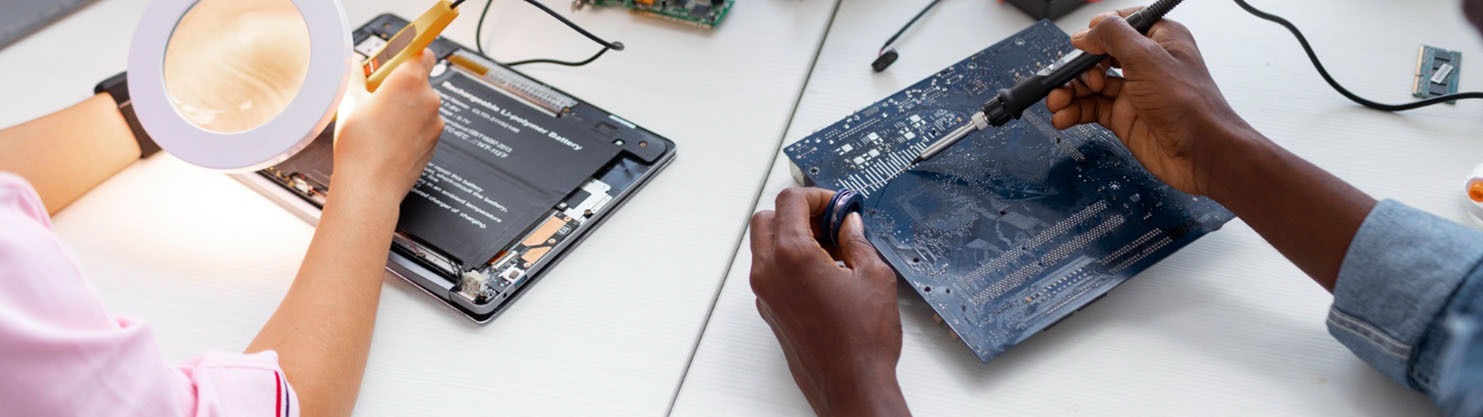
The BTech in Electronics Engineering (VLSI Design & Technology) at Nitte Meenakshi Institute of Technology (NMIT), Bengaluru, under Nitte (Deemed to be University), is a four-year undergraduate engineering program focused on semiconductor technology, integrated-circuit design, VLSI systems and modern electronic hardware.
The program covers analog and digital VLSI design, ASIC and System-on-Chip (SoC) development, design verification, physical design and Field-Programmable Gate Array (FPGA) systems. Through laboratory work, technical projects and exposure to Electronic Design Automation (EDA) tools, students learn concepts and techniques used in semiconductor and chip-design applications.
| Particular | Details |
|---|---|
| Program | BTech in Electronics Engineering (VLSI Design & Technology) |
| Institution | Nitte Meenakshi Institute of Technology (NMIT), Bengaluru |
| University | Nitte (Deemed to be University), Mangaluru |
| Degree | Bachelor of Technology (BTech) |
| Duration | 4 Years / 8 Semesters |
| Intake | 60 Students |
| Established | 2023 |
| Admission | NUCAT, as applicable |
| Key Areas | RTL Design, ASIC/FPGA Design, Physical Design, VLSI Testing and Verification, AI/ML Applications in VLSI, SoC Design. |
| Mode | Full-time undergraduate engineering program |
The BTech in Electronics Engineering (VLSI Design & Technology) program at NMIT, Bengaluru, covers semiconductor technology, integrated-circuit design, verification, physical design and testing. Students learn these areas through classroom instruction, laboratory work, projects and practical use of VLSI design tools.
Key Highlights
On completing the program, graduates will be able to:
Empowering students in fostering skills, research and innovation through academic excellence and industry collaboration for driving the development of cutting-edge and sustainable semiconductor solutions.
| Specifications | No of Computers |
|---|---|
| Intel Corei9-14900 5.80G 36MB 24 Cores 65W CPU, Intel W680 Chipset Mother Board 32GB DDR5, NVIDIA Memory RTX5070 12GB, 1TB Hard Disk, Windows 11 Pro 64 | 25 |
| Intel Core i9-14900 5.8G 36Mb 24 cores 65W CPU-1x Intel B760 MotherBoard, Deepcool CPU Cooler, 32GB DDR5, 1TB NVME, Window 1X11 pro 64bit Version | 22 |
| Intel Corei7, 16GB RAM with 1TB hard disk | 23 |
| Specifications | No of Licenses |
|---|---|
| XILINX VIVADO ML ENTERPRISE EDITION FLOATING LICENSE | 25 |
| CADENCE UNIVERSITY LEVEL 1 BUNDLE | 40 |
| Specifications | No of Boards |
|---|---|
| PYNQ 22 FPGA Board | 20 |
Board of Studies (BOS)
| Name | Designation | Affiliation | Role |
|---|---|---|---|
| Prof. Rathnamala Rao | Associate Professor | Department of ECE, NITK, Surathkal | External BoS Member |
| Dr. Premananda B. S | Associate Professor | Department of Telecommunication & Engineering, RV College of Engineering, Bengaluru. premanandabs@rvce.edu.in, 9844531730 | Academics |
| Mr. Chandrashekar B U | Principal Engineer, R&D | Synopsys | Industry |
| Mr. Shivaprasad B K | Execution Manager | Entuple Technologies Pvt. Ltd. | Industry |
| Ms. Ashwini Hegde | Design Engineer | Entuple Technologies Pvt. Ltd. | Alumni |
Board of Examiners (BOE)
| Faculty Name | Designation | Affiliation |
|---|---|---|
| Dr. Parameshachari B D | Professor & Head | Chairman BoE |
| Dr. Sowmya Madhavan | Associate Professor | BoE Member |
| Dr. Rekha Phadke | Associate Professor | BoE Member |
| Dr. Shashidhara K S | Associate Professor | BoE Member |
| Dr. Naveen I G | Associate Professor | BoE Member |
The Department of VLSI Design has undertaken significant initiatives to strengthen the teaching-learning process, with a focus on innovative pedagogical approaches that promote active learning, critical thinking and student engagement. These strategies emphasize dynamic, interactive and student-centered learning experiences tailored to the specialized nature of VLSI design and semiconductor technology. By integrating mini projects, hands-on lab components, problem-solving exercises and hardware-software co-design tools, the department aims to create a learning environment that bridges theoretical concepts with practical circuit design and chip-level implementation. This approach fosters creativity, collaboration and a deeper understanding of VLSI design flows — from schematic capture and simulation to layout and verification.
Below is a table highlighting key pedagogical tools and strategies, including mini projects and lab components, along with their descriptions and links to additional resources for effective implementation.
| Teaching-Learning Activity | Description |
|---|---|
| Project-Based Learning | Students work on real-world projects that connect theoretical knowledge with practical application, helping them develop a deeper understanding through hands-on learning. |
| Simulation/Experimental Learning | Real-world scenarios are simulated to enhance understanding through experimentation. |
| Quizzes | Quick assessments used to measure learning progress and reinforce essential concepts. |
| Surprise Tests | Unplanned assessments aimed at keeping students consistently prepared and engaged. |
| Certification Courses | Motivated students to enroll in certification courses offered by NPTEL and Infosys Springboard to strengthen their subject knowledge and practical skills. |
| Guest Lectures | Sessions conducted by experts from academia or industry to provide specialized insights. |
| Role Play/ Model based demonstration | Enhances leadership and collaboration skills while providing practical exposure to engineering solutions in real-world scenarios. |
| Industrial Visits | Industrial visits provide students with real-world exposure to industry practices, work environments, and professional operations. |
| Seminars | Seminars where students present and discuss technical topics to enhance their communication, presentation, and analytical skills. |
| Case Study | Case studies involve the analysis of real-world scenarios to develop critical thinking, problem-solving skills, and the ability to apply theoretical knowledge to practical situations. |
| Learning Assignments | Assignments designed to promote critical thinking and the application of theoretical knowledge to real-world problems. |
Basic Eligibility
Pass in Class 12 or equivalent examination with not less than 50% aggregate marks in Physics, Mathematics and any one of Chemistry, Biology, Biotechnology, Computer Science, Electronics or Information Technology, with English as one of the languages of study, from a recognized Board.
Entrance Exam Requirement
Admission Process
Application Deadlines and Important Dates
Details of the deadlines and important dates with respect to the admission process are available at the official NUCAT website.
Fee Structure
The fee structure for B.Tech and other programs is available through the official Nitte fee structure page.
Candidates should refer to the latest fee information applicable to their admission category and academic year.
The curriculum follows the VLSI design flow and semiconductor technology, progressing from electronics fundamentals to digital systems, VLSI circuits, design automation, FPGA systems and advanced chip-design concepts.
Key subject areas include:
Teaching-Learning Methodology
The teaching-learning approach combines theoretical instruction with practical application through:
Click the below link to download the curriculum:https://drive.google.com/file/d/18LzKBFDyMTIgfZweCVAHHi-DTAuGveA8
The department’s faculty expertise includes semiconductor technology, integrated-circuit design, VLSI verification, physical design and testing. Faculty members guide students through coursework, laboratory sessions and technical projects in these areas.
Library Resources & Digital Tools
Students enrolled in the VLSI Design & Technology can use library resources, including textbooks, research journals, e-books and online databases, to support their coursework, projects and research.
Labs & Infrastructure
The department provides resources for VLSI design, FPGA development, circuit simulation and electronics prototyping. Available resources include:
Graduates can pursue careers in fabless semiconductor companies, chip-design organizations, semiconductor manufacturing and testing, embedded hardware and electronics R&D.
Potential job roles include:
After BTech in Electronics Engineering (VLSI Design & Technology), graduates can pursue postgraduate and research programs in India and abroad in the following areas:
The department’s research and innovation areas include VLSI design, ASICs, AI hardware, low-power VLSI, physical design, neuromorphic computing, 5G/6G systems, nanoelectronics, intelligent sensing and signal processing.
Research and innovation highlights include:
Patents
2025-2026
| Title | Application Number | Filing / Granted Date | Inventors | Application Status |
|---|---|---|---|---|
| Smart Channel Coding device for Energy-Efficient 5G/6G New Radio Devices | 6513244 | 17-03-2026 | Dr. Naveen I G | Granted |
| AN AI-ENABLED SYSTEM-ON-CHIP ARCHITECTURE WITH POLICY-DRIVEN CONTROL OF COMPUTE, MEMORY, AND POWER | 202541133555 | 09-01-2026 | Dr. Sowmya Madhavan | Published |
| System, Method, Design and Development of Innovative H-Frame Drone for Solar Panel Cleaning and High-Rise Buildings | 202541076696 | 05-09-2025 | Dr. Murthy M | Published |
| HUMAN POSE ESTIMATION THREAT DETECTION SYSTEM | 202541119684 | 05-09-2025 | Ms. Harshitha G M | Published |
| HI-SHAPED UNIFORM LINEAR ARRAY BASED MULTIPLE SIGNAL CLASSIFICATION SYSTEM FOR THE DIRECTION OF ARRIVAL ESTIMATION | - | 13-02-2023 | Dr. Shashidhara K S | Granted |
The department conducts technical workshops, training programs and industry-interaction activities related to VLSI, FPGA design, embedded systems and semiconductor technology.
Activities and initiatives include:
Events Organized / Conducted / Resource Person
| Title of the Workshop/ FDP/ Seminar | Date | FDP/Workshop/Conference/Seminars | Coordinator |
|---|---|---|---|
| Orientation Program for Newly Inducted Faculty Members | 05-01-2026 to 09-01-2026 | Workshop | Dr Sowmya Madhavan |
| NASSCOM Embedded Software Program | 29-12-2025 to 03-01-2026 | Workshop | Dr Sowmya Madhavan |
| Industry driven Skill development program on Embedded System Design | 25/04/2026 | Skill Development Program | Dr. Naveen I G Dr. Shashidhara K S |
| ADVANCED FPGA LAB USING PYNQ Z2BOARDS | 05-08-2025 to 09-08-2025 | FDP | Dr Sowmya Madhavan |
| SEMI-TECH: Semiconductor Innovation & Technology for Next-Gen Electronics | 2025-08-18 to 2025-08-23 | FDP | Dr Sowmya Madhavan |
| Hardware Accelerators for Next-Generation Systems: PYNQ-Z2 and TCL-Based Design Methodologies | 29-06-2026 to 03-06-2026 | FDP | Dr. Naveen I. G and Dr. Shashidhara K. S |
Event Attended
| Title | Date | FDP/Workshop/Conference/Seminars | Coordinator |
|---|---|---|---|
| Faculty Excellence in the age of Brain Computer Interfaces: Critical Thinking, Leadership and Team building | 05-03-2026 to 07-03-2026 | Workshop | Dr. Sowmya Madhavan |
| INTERNATIONAL SYMPOSIUM ON SCIENCE BEYOND BOUNDARY - INVENTION, DISCOVERY, INNOVATION AND SOCIETY (RASAYAN 22) | 08-01-2026 to 10-01-2026 | Conference | Dr. Sowmya Madhavan |
| How AI is changing Retail and Consumer Packaged Goods (RCPG)” & “Gap Between Academia and Industry in AI & Data Analytics | 29-04-2025 | Seminars | Harshitha G M |
| Exploring the Synergy between eAcoustics and Machine Learning for Tomorrow’s Technologies (ATAL FDP) | 15-12-2025 to 20-12-2025 | Workshops | Mr. Sai Prabhu K.B. |
| Generative AI literacy Aligned to competency standards developed by IT-ITes Sector skill council ( Upskilling) | 13-12-2025 to 15-12-2025 | Workshops | Mr. Sai Prabhu K.B. |
| MAT LAB EXPO | 7-5-2026 | Seminars | Dr.Naveen I G |
| Emerging 2D Semiconductor Devices: Powering the Future of Nano architectonics | 20-12-2025 to 25-12-2025 | FDP | Dr. Sowmya Madhavan |
| SEMI-TECH: Semiconductor Innovation & Technology for Next-Gen Electronics | 18-08-2025 to 23-8-2025 | FDP | Dr. Sowmya Madhavan |
| Neural Networks and Natural Language Processing | Jan 2026 to May 2026 | FDP | Mr. Sai Prabhu K.B. |
2026
Students participate in technical competitions, innovation programs and industry-linked design activities. Recent achievements and participation include:
2025
Faculty Achievements
Student Achievements
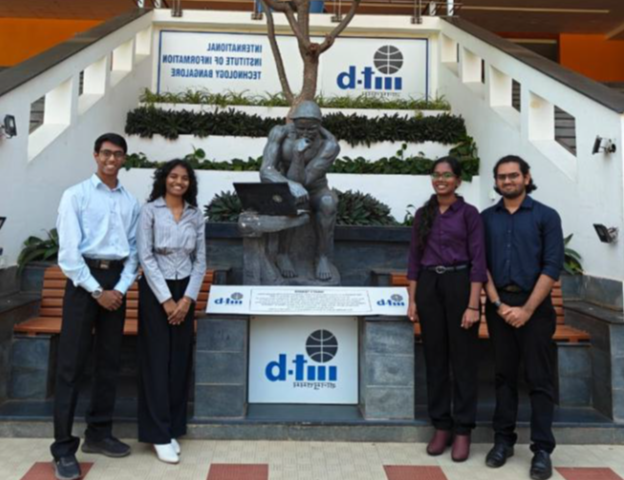
Project Exhibition
Professional Societies
| Industry / Organization Name | Month / Year of Execution | Objective | Status of the MoU / Expiry date of MoU | SPOC / Dy SPOC |
|---|---|---|---|---|
| Sasken technologies Limited | 17th Novemeber 2025 | Certification courses, Internship, Project Work, Placement for Students | Active / November 2027 | Dr. Shashidhara K S, Dr.Naveen I G |
The Department of Electronics Engineering (VLSI Design & Technology) organized VORTEX VINYASA 2026 – Industry Conclave on 13th February 2026 to connect academia with industry in VLSI and semiconductor domains. The event featured keynote talks by Dr. Prabhakar Mishra and Lakshmanan Balasubramanian, along with a panel discussion moderated by Shaik Aleem Ur Rehaman, focusing on industry expectations and career opportunities. The conclave provided students with valuable industry exposure, professional guidance, and networking opportunities.

























NMIT provides institute-level placement and career development support through aptitude, soft-skills and technical training, specialized technology training, live-project exposure, internships and entrepreneurship opportunities.
1. What is B.Tech in Electronics Engineering (VLSI Design & Technology)?
It is a four-year undergraduate engineering program focused on semiconductor devices, integrated circuits, VLSI design, chip verification, FPGA systems and related technologies.
2. What is the basic eligibility for admission to the VLSI Design & Technology program at NMIT?
Candidates must have passed Class 12 or equivalent examination with not less than 50% aggregate marks in Physics, Mathematics and any one of Chemistry, Biology, Biotechnology, Computer Science, Electronics or Information Technology, with English as one of the languages of study, from a recognized Board.
3. Is NUCAT required for B.Tech in Electronics Engineering (VLSI Design & Technology)?
Candidates seeking admission through the regular admission process are required to appear for NUCAT, as applicable. NUCAT is a 120-minute entrance examination covering Physics, Chemistry and Mathematics.
4. Is KCET or COMEDK required for B.Tech in Electronics Engineering (VLSI Design & Technology) at NMIT?
No. Seat allotment for B.Tech in Electronics Engineering (VLSI Design & Technology) at NMIT is not through KCET or COMEDK. Candidates seeking admission through the regular admission process are required to appear for the Nitte University Common Admission Test (NUCAT), as applicable.
5. What subjects are covered in VLSI Design & Technology?
Key areas include semiconductor devices, analog and digital electronics, CMOS VLSI, ASIC and FPGA design, SystemVerilog, UVM, physical design, static timing analysis, verification, testing and RISC-V architecture.
6. What are the major career roles?
Career roles include RTL Design Engineer, Verification Engineer, DFT Engineer, Analog Design Engineer, Physical Design Engineer, Physical Verification Engineer, CAD/EDA Engineer, FPGA Engineer and Microarchitecture Engineer.
7. Does the program include practical VLSI tools?
Yes. The department provides Cadence, Xilinx Vivado ML Enterprise Edition, Xilinx Vitis HLS, MATLAB, PYNQ FPGA boards and RISC-V development kits for laboratory work and projects.
8. Does the department offer research opportunities in AI hardware and semiconductor technology?
Yes. The department's research areas include ASICs for AI, neuromorphic computing, low-power VLSI, nanoelectronics, signal processing, 5G/6G systems and intelligent sensing.
9. Can graduates pursue higher studies after this program?
Yes. Graduates can pursue postgraduate studies and research in VLSI, microelectronics, semiconductor technology, integrated-circuit design and related fields, subject to the eligibility criteria of the institutions concerned.
10. Is the program suitable for students interested in chip design?
Yes. The program is designed around VLSI design and semiconductor technology and provides exposure to major stages of chip development.
Have questions about the program? Connect with our team or take the first step toward your future.

Take the next step toward building your career. Register online and begin your application today.
Apply Online ↗
Reach out to us for admission-related assistance.


Get assistance with NRI category queries.

BE, MTech, PhD (PG Coordinator)
15+ Years
Basic Electronics, Analog Electronic Circuits, Fundamentals of VLSI Design, CMOS VLSI Design, Real Time Operating Systems, ASIC Design, Field Programmable Gate Arrays, Digital System Design using Verilog, Analog and Mixed Mode VLSI Design, Optical Fibre Communication, LTE and Beyond 5G, Digital System Design.
ORCID ID: https://orcid.org/0000-0001-5987-8617
Google Scholar: https://scholar.google.co.in/citations?user=W6uU_PUAAAAJ&hl=en
LinkedIn Profile: https://www.linkedin.com/in/sowmya-madhavan-7486268b/

BE, MTech
VLSI and Embedded Systems.
Design of Digital and Analog Circuits, Applications of C and C++.

BE, MTech, (PhD)
10+ years
VM provisioning in cloud computing
Analog electronics, Industrial electronics, Digital electronics, Embedded C Programming

BE, MTech, PhD
5+Years
2DNano materials, Nano Electronics, Li-ion Battery, Bio Sensors
Nano Electronics, Data Communication, Wireless Communication, Basic Electronics.
Google Scholar Id: https://scholar.google.com/citations?user=Y1GpU6AAAAAJ&hl=en
Orcid Id: https://orcid.org/0000-0003-2915-8410
LinkedIn Profile: https://www.linkedin.com/in/murthy-m-4b1796209/

BE, MTech
10+ years
Embedded Systems and IoT
Analog and Digital Electronics, Computer Networks, Embedded Systems, Internet of Things (IOT), Research Methodology, Basic Electronics, Embedded C.
Google Scholar ID: https://scholar.google.com/citations?hl=en&user=8Oq0z50AAAAJ

BE, MTech, Ph.D
15+ Years
•A Book authored Titled "VLSI Circuits" for the 7th VTU syllabus 2006
• Certificate of Appreciation "fostering the ecosystem bridging gap Government, Academia and Industry", By TI & AICTE
• BOSCH Certified Skill Trainer (NSDC)
• Session Chair, "InternationalConference on 'Advances in Communication and Computing and Technology'(ICACCT-2021), Organized by the guru Nanak Dev Engineering College, Bidar, Karnataka, India in joint collaboration with Universiti Tunku Abdul Rahman, Malaysia and Universiti Teknologi PETRONAS, Malaysia 28& 29, December-2021."
• Technical Advisor, Artisense Technologies Pvt. Ltd.
• SPOC, KSCST
Elected EXECOM Member for the IEEE AP-MTT Bangalore Joint Chapter and the IEEE AESS Bangalore Chapter 09-03-2025
Elected as the EXECOM Member - IEEE CASS, Bangalore Section 28-01-2025
Resource person for Employment-Based In-House Internship Training organized by Department of Electrical and Electronics Engineering, in association with Goldlight Technologies Pvt. Ltd., Bengaluru on 10-7-2025.
VLSI Design, ASIC Design, FPGA Architecture and Applications, Digital Signal Processing, Digital System Design Using Verilog, System Verilog, Embedded System using FPGA and Statistical Signal Processing.
• Low Cost Health Monitoring and Management Systems for Elderly People in Rural Areas.
• Low Cost Solution for Cooling Systems for Rural Areas Thermoelectric Materials
• GSM Enabled Automated and Remote Monitoring Irrigation System for Rural Areas
• Low Cost Solution for Automated Irrigation System Using MSP430 Microcontroller
• Detection and Monitoring Of Minerals/Nutrients and Pollutants in Water to Aid Crop Growth in Rural Areas Using Under Water Robot
ORCID ID: https://orcid.org/0000-0002-8223-1026
Google_Scholar_ID: http://scholar.google.co.in/citations?user=S8_SELUYLw4C&hl=en
LinkedIn Profile: https://www.linkedin.com/in/dr-shashidhara-ks-734131205/
B.E, M.Tech, Ph.D
15+ Years
Analog and Mixed Mode VLSI Design, ASIC Design
ASIC Design, Analog Electronics, Advanced VLSI Design, Basic Electronics, C Programming, Digital Electronics, DSD Using Verilog, Embedded System Design, GSM, Microcontroller 8051, Micro-Electronics, Real Time Operating Systems, Real Time Embedded Systems, VLSI Design, VLSI System Design.
Google Scholar ID: https://scholar.google.com/citations?user=6-KW-84AAAAJ&hl=en&authuser=2
ORCID ID: https://orcid.org/0000-0002-3782-1174

M.Tech
Teaching: PES University, Jain University, Ramaiah Skill Academy
Industry: ChipEdge Technologies, Thinsil Technology
Low Power VLSI, RISC V, Physical Design, STA
Department Responsibilities: Project Coordinator, SEE Coordinator
LinkedIn Profile: linkedin.com/in/raghavendra-m-824635432

BE, MTech, PhD
11 years , Industry 7 years.
Digital Design, Synthesis, Physical Design, Static Timing Analysis, Signoff
Co-Investigator: Design, simulation and Modeling of MEMS Microphone Array and signal conditioning electronics, funded by SITAR-DRDO, Rs 7.00 Lakhs.

M. Tech (VLSI Design and Embedded System)
Digital Electronics, Digital VLSI Design, RTL Design and Verification, ASIC Design
GATE Qualified, UGC NET Qualified (99.6 percentile)
Autonomous Tool Coordinator, LMS Cordinator, IIC
Digital System Design with HDL, Digital VLSI,
ORCID ID: 0009-0005-6041-9350
