Key Takeaways
- Drone swarm is a cluster of small drones whose mission is the same and they act as one.
- Swarms will not take the place of larger aircraft, they are expected to operate in conjunction with them.
- Swarms can assist in the India border surveillance, search and rescue, and disaster response.
- A five-drone swarm for the first time flew together successfully at NMIT and was used for traffic monitoring, precision agriculture and a night light show.
What Is a Drone Swarm?
A single drone is used to fly an individual mission. In a swarm, each drone is aware of where it fits in the swarm and acts as part of the whole, thus moving as a swarm and not as individual flights.
This is possible with three ideas:
- A common objective, all drones share, reach.
- Coordinating master drone to control the group.
- Follower drones that duplicate the positions of the master drone and maintain the formation.
- Important note: No swarms are expected to be replacing larger aircraft. They will probably be operating in their company; doing tasks that many low-cost, small drones can do a good job.
Why Drone Swarms Matter for Indian Defence
For a nation such as India, where borders are long, the land is difficult, and there is an ever-present requirement for surveillance and prompt response, swarms have a significant impact.
- A swarm can cover larger areas more quickly.
- Keep watch over hard-to-reach locations.
- Aid in the search and rescue mission.
- To remain effective in the event of a drone loss.
- Is often more economical than single large aircraft.
The small size of the drone also means that the swarm can be developed gradually and can be modified according to the different work, such as to observe a specific section of border or to assist in a disaster area.
What We Built at NMIT
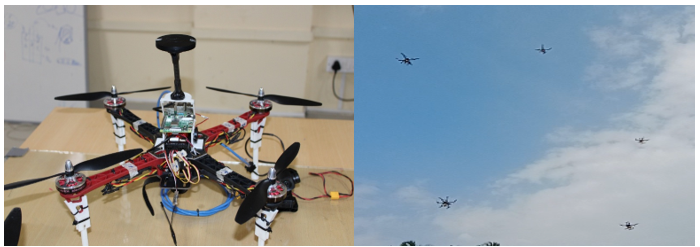
The team at Aerospace & Defence R&D Center, Nitte Meenakshi Institute of Technology constructed a swarm from scratch as part of the project of the Dassault Systèmes La Fondation. We developed two kinds of drones:
- A six rotor hexacopter for heavier applications like spraying.
- A smaller quadcopter with 4 rotors for shooting videos.
- They were both equipped with a common electronic brain to enable them to depart, fly in formation and re-join.
How the Swarm Is Controlled
The idea is simple. A ground station sends the mission to one master drone, and the master passes instructions on to the follower drones. Because the master does the coordinating, the swarm keeps flying even if the link to the ground is lost.
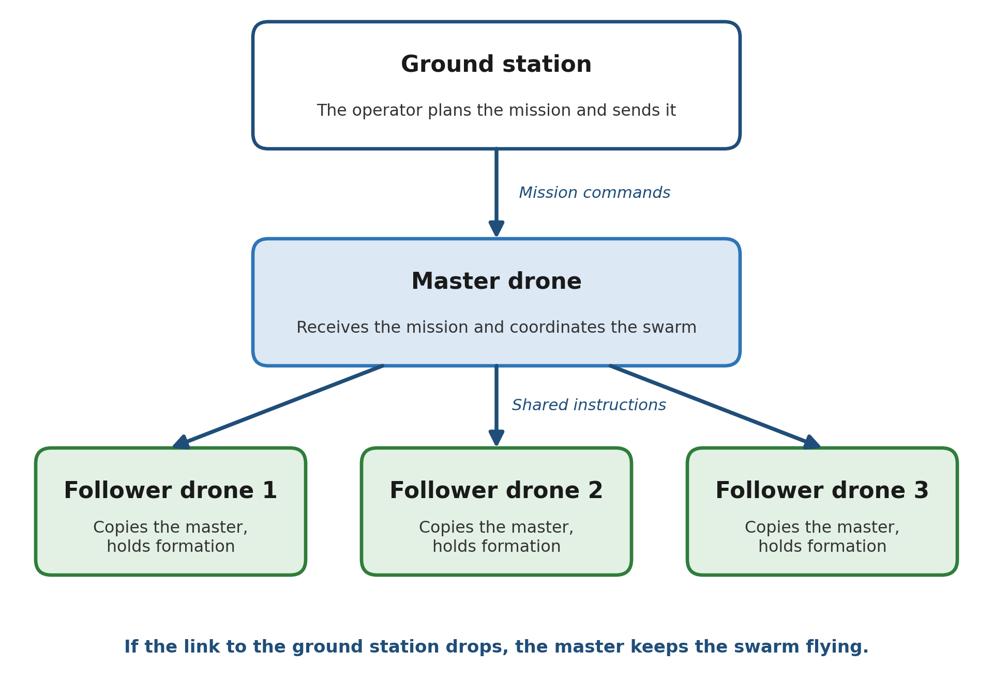
We tested the system step by step, from a single drone to two, then three, and finally five drones flying together in a stable formation. This was our first successful formation flight.
Real-World Applications We Tested
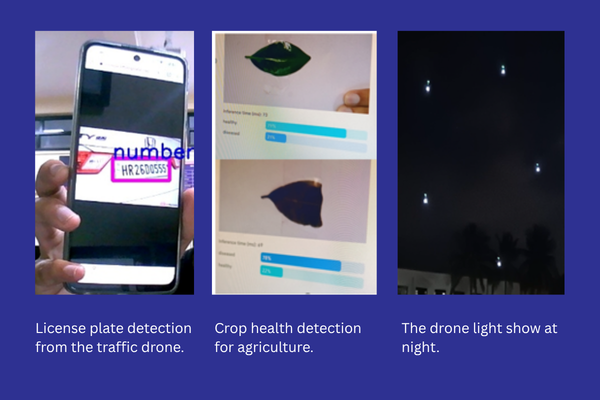
The potential applications of drone swarms extend across several areas. We have already tested three of them.
1. Traffic Enforcement (Quadcopters)
For the Bengaluru Traffic Police, our quadcopters carried cameras and AI software to watch traffic from above. They can:
- Read number plates.
- Spot violations such as riding without a helmet, wrong-way driving and triple riding.
- Estimate how fast vehicles are moving.
- Count vehicles at busy junctions to help plan signal timing.
2. Precision Agriculture (Hexacopters)
For the University of Agricultural Sciences, Bangalore, one hexacopter scanned a pigeon pea field and spotted pod borer damage, marking each affected patch. A second hexacopter then flew to exactly those spots and sprayed only what was needed, saving both time and pesticide.
3. Night Light Show
Five drones fitted with LED lights flew a choreographed show at night, moving in sync with precise positioning. It is a reusable, reprogrammable alternative to fireworks.
The Challenges Ahead
Despite its capabilities, swarm technology is still an emerging field. When flying in formation there are practical issues to be aware of including maintaining safe separation, maintaining a synchronized flight and maintaining a formation in the wind. Good communication between the drones is as important. These solutions will determine the speed at which swarms will progress from test flights to more complex missions.
Creating the Swarm-Ready Future
Drone swarms represent more than a bigger fleet of drones. They are a novel approach to the co-operation of machines. We have proven formation flight and have tested three actual applications—we can now expand our swarms to larger sizes and more complex missions such as surveillance and search and rescue.
That's also a chance for engineering institutions to give students and researchers the chance to contribute to the development of new technologies before they become commonplace.
The questions swarms ask are here. How many machines will coordinate? What happens in the event of failure in missions? How will engineers design systems for tasks which one drone can't perform? The answer remains to be discovered, and that's why drone swarms are one of the most fascinating fields of technology to be involved in today.
Frequently Asked Questions
1. What does a drone swarm mean?
A drone swarm is a collection of smaller drones which perform a common mission, communicate with each other and adapt to one another like a flock of birds.
2. How do the drones in a swarm coordinate?
A ground station communicates with one master drone, which then relays the instructions to the follower drones. The followers copy the moves of the leader and hold formation.
Will swarms take the place of larger aircraft?
No. Swarms are likely to exist in parallel to larger aircraft, and will perform tasks where numerous small, low-cost drones have a distinct advantage.
What if it goes down with the loss of connection to the ground station?
The swarm continues to fly even if the communication between the swarm and the ground is interrupted due to the fact that the master drone is responsible for the coordination.
What are the key problems in swarm flight?
Safe distances, synced drones, wind-held formation, reliable communications between drones.
Want to work on technologies like this?
Explore the BTech in Aeronautical Engineering at NMIT. https://nitte.edu.in/nmit/btech-aeronautical-engineering.php