When the Medicine Is a Living Cell
What if a medicine could recognize a disease, respond to it and continue functioning inside the body?
This is the principle behind chimeric antigen receptor T-cell (CAR-T) therapy, one of the most important advances in modern cellular medicine. Unlike conventional medicines, CAR-T therapy uses genetically engineered immune cells as the therapeutic agent itself.
How Does CAR-T Therapy Work?
CAR-T therapy begins by collecting T lymphocytes, usually from the patient. These immune cells are genetically modified to express a chimeric antigen receptor (CAR) that enables them to recognize a selected antigen on diseased cells.
The engineered cells are expanded under controlled manufacturing conditions, undergo quality assessment and are subsequently administered to the patient. Once inside the body, they can recognize their target and activate an immune response.
Since its first clinical approval in 2017, CAR-T therapy has transformed treatment for several difficult-to-treat haematological malignancies, including certain leukemias, lymphomas and multiple myeloma.
Beyond Cancer: A New Therapeutic Frontier
The field is now moving beyond oncology. Researchers are investigating engineered cellular therapies for autoimmune diseases and other immune-mediated disorders, where selectively targeting disease-driving immune cells could potentially produce deeper and more durable immune control than conventional systemic immunosuppression.
Importantly, many of these applications remain investigational. Early clinical studies have generated considerable interest, but their long-term efficacy and safety require continued evaluation.
The Next Frontier: In-Vivo CAR Engineering
A particularly exciting direction is in-vivo CAR engineering.
Conventional CAR-T therapy involves complex ex-vivo manufacturing: cell collection, genetic modification, expansion, quality testing and reinfusion. In-vivo approaches seek to deliver genetic instructions directly to selected immune cells within the patient, potentially reducing manufacturing complexity and enabling more accessible cellular therapies.
This is where CAR-T research increasingly intersects with pharmaceutics and nanomedicine. Targeted nanoparticles, lipid-based systems, viral vectors and bioinstructive biomaterials are being investigated as platforms for delivering genetic payloads and programming immune cells within the body. These approaches are promising, but most remain under active research and development.
Where Does Pharmaceutics Fit?
CAR-T therapy challenges the conventional definition of a pharmaceutical product. The therapeutic entity is not simply a molecule—it is a living, engineered cell.
This creates important pharmaceutical challenges involving cell processing, cryopreservation, stability, viability, potency, critical quality attributes, process control and scalable manufacturing. Recent advances increasingly emphasize closed systems, analytical controls, automation and standardized manufacturing processes to improve reproducibility and accessibility.
For pharmaceutical scientists, the emerging question is therefore not only:
How do we deliver a drug to a cell?
How do we safely deliver an instruction that programs the cell to become the medicine?
- CAR-T technology represents a convergence of pharmaceutics, immunology, biotechnology, genetic engineering, nanotechnology and synthetic biology.
- Its evolution from an advanced cancer therapy toward programmable cellular medicine could open new therapeutic possibilities. However, challenges involving safety, specificity, manufacturing complexity, accessibility and long-term control remain.
- The future of therapeutics may not simply be about designing better drugs—it may increasingly involve designing cells that function as drugs.
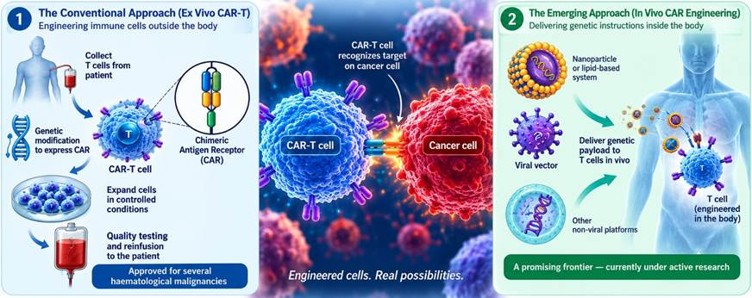
Illustration depicting the conventional ex vivo CAR-T workflow, CAR-T-mediated target-cell recognition, and the emerging concept of in vivo CAR engineering using genetic-delivery platforms.
About the Author
Mr. Ziaul Karim is an Assistant Professor in the Department of Pharmaceutics at Nitte College of Pharmaceutical Sciences, Nitte (Deemed to be University), Bengaluru. His academic and research interests include advanced drug delivery, nanotechnology, nanomedicine, biomaterials, formulation development, pharmaceutical optimization and translational pharmaceutical research.